



Sorry, no sales person is available right now to take your call. Pls leave a message and we will reply to you via email as soon as possible.
Home/ PCB News/ How Do Ceramics and Metals "Join Forces"? A Detailed Explanation of Core Metallization Processes such as DBC and AMB
How Do Ceramics and Metals "Join Forces"? A Detailed Explanation of Core Metallization Processes such as DBC and AMB
2026-08-17
Ceramics and metals are two key classes of materials with highly complementary physical properties in the field of high-end manufacturing. Metals excel in plasticity, electrical conductivity, and thermal conductivity, making them ideal for structural support and electrical interconnection; ceramics, on the other hand, maintain stable performance under extreme conditions due to their high electrical insulation, high-temperature resistance, corrosion resistance, high hardness, and low thermal expansion. However, their significant differences in chemical bonding, coefficient of thermal expansion (CTE), and wettability make reliable direct joining via conventional welding methods extremely challenging.
Ceramic metallization technology has thus emerged to address this challenge. Its core principle involves depositing a firmly adhered, stable metal film onto the ceramic surface, thereby enabling the originally insulating ceramic to become solderable. This facilitates high-strength, hermetic, and highly reliable bonding between ceramic and metal components, forming a critical foundation for heterogeneous material integration in advanced manufacturing. Originating in the early 20th century, systematic experiments were first conducted by American researchers Charles W. Wood and Albert D. Wilson in 1903, leading to the granting of the first patent in 1905. After a century of iterative development, the technology has matured into industrial-scale applications and is now widely used in high-temperature precision devices, advanced electronic packaging, and vacuum electronic equipment.
Currently, the industry has established several mature ceramic metallization technology pathways, including molybdenum-manganese (Mo-Mn) sintering, various electroplating processes (gold, copper, nickel, and tin plating), laser-assisted plating (LAP), direct bond copper (DBC), and active metal brazing (AMB). Due to significant differences in surface characteristics, crystal structures, and thermal properties among various ceramic substrates, the optimal metallization process, processing parameters, and application scenarios also vary accordingly. The following sections systematically elaborate on the metallization principles, key parameters, and technical features for the four most commonly used ceramic substrates in industrial applications.
Beryllium Oxide (BeO) Ceramics – Mo-Mn Sintering for High Thermal Conductivity Applications
Beryllium oxide (BeO) ceramics exhibit exceptionally high thermal conductivity, making them an ideal substrate for high-power heat dissipation components. For this material, the most mature and widely adopted metallization method in the industry is the molybdenum-manganese (Mo-Mn) sintering process.
The process involves formulating a homogeneous slurry from molybdenum powder, manganese powder, and specialized metal oxide additives in precise proportions, which is then coated onto a cleaned BeO ceramic surface. Subsequently, the coated part is sintered at high temperature in a controlled furnace to form a dense and strongly bonded metallic transition layer. A critical parameter is the manganese content, which must be strictly maintained within 10%–25% by mass. Manganese primarily enhances the wettability of the metal slurry on the ceramic substrate, promoting interfacial fusion between the metal and ceramic phases and significantly improving the adhesion of the metal film. This ensures long-term hermeticity and service reliability of the sealed component. This process is highly compatible with the physicochemical properties of BeO ceramics, yielding products that combine high thermal conductivity with strong bonding—particularly suitable for high heat-flux dissipation assemblies.
Alumina (Al₂O₃) Ceramics – DBC as the Preferred Process for Scalable Copper Cladding
Alumina (Al₂O₃) ceramics are the most widely used insulating substrate in industrial applications due to their excellent cost-performance ratio, stable insulation properties, and superior mechanical strength. The dominant metallization approach for this material is the Direct Bond Copper (DBC) process. This technique enables high-strength bonding between copper foil and alumina ceramic without requiring an additional intermediate layer, serving as a core technology for power electronic substrate fabrication.
The complete process begins with degreasing, surface roughening, and activation pretreatments of both the copper foil and alumina ceramic to enhance surface cleanliness and wettability. The copper foil is then laminated onto the ceramic surface and heated in a controlled oxygen-containing inert atmosphere using a ramped temperature profile. When the temperature reaches the Cu-O eutectic liquid phase range, controlled oxidation occurs on the copper surface, generating a copper-based liquid phase that thoroughly wets the Al₂O₃ surface, establishing initial bonding. During cooling, a uniform Cu-Cu₂O eutectic microstructure precipitates at the interface, forming a dense metallurgical bond and ultimately yielding a high-strength copper-clad structure. This process delivers high interfacial strength, excellent electrical and thermal conductivity, and good process consistency, making it well-suited for mass production and widely applied in standard power semiconductor substrates and consumer electronic packaging.
Aluminum Nitride (AlN) Ceramics – Dual-Process Compatibility for Mid-to-High-End Thermal Management
Aluminum nitride (AlN) ceramics offer higher thermal conductivity than alumina, along with excellent electrical insulation and a lower coefficient of thermal expansion, making them an ideal heat-spreading substrate for mid-to-high-end power devices. Metallization of AlN can be achieved via either DBC (with pre-oxidation) or Active Metal Brazing (AMB), with selection based on specific operational requirements.
1. DBC Process (Requires Pre-Oxidation)
Since AlN is a non-oxide ceramic with inherently high chemical stability, it cannot readily form a liquid phase with good wettability. Therefore, a pre-oxidation step is essential: the AlN ceramic is heated to approximately 1200°C in a controlled atmosphere to grow a dense 1–2 μm oxide layer on its surface, improving wettability. Subsequently, standard DBC processing is applied to bond the copper foil, achieving a robust cladded structure.
2. AMB Active Metal Brazing Process
This process employs a silver-copper-titanium (Ag-Cu-Ti) alloy as the braze filler, typically composed of 67%–71% Ag, 28% Cu, and 1%–5% active Ti. Titanium is the key functional element, capable of reacting specifically with the AlN substrate to form a stable interfacial transition layer, effectively resolving the challenge of heterogeneous bonding. AMB yields joints with higher interfacial strength and superior high-temperature performance. However, it also has inherent limitations: the significant mismatch in CTE between ceramic and metal leads to residual thermal stress at the interface, which may cause delamination or debonding under prolonged thermal cycling. To mitigate this, industrial practices often incorporate functional fillers such as SiC, Mo, TiN, Si₃N₄, or Al₂O₃ into the braze alloy to buffer thermal mismatch, relieve residual stress, and significantly enhance the component’s thermal shock resistance and service life.
Silicon Nitride (Si₃N₄) Ceramics – AMB as the Exclusive Process for High-Reliability Applications
Silicon nitride (Si₃N₄) ceramics possess ultra-high mechanical strength, exceptional thermal shock resistance, high-temperature stability, and outstanding aging resistance, making them the preferred substrate for high-voltage, high-reliability power devices. This material is exclusively compatible with the AMB active metal brazing process and is unsuitable for DBC.
Mechanistically, Si₃N₄ cannot form a suitable oxide layer through pre-oxidation to enable DBC bonding. However, as a nitride ceramic, it readily reacts with active metals such as Ti, Cr, or V to form a continuous and dense nitride-based interfacial transition layer, ensuring strong bonding. Consequently, AMB remains the only industrially mature metallization route for Si₃N₄. Although the conventional Ag-Cu-Ti braze system demonstrates good compatibility, it suffers from notable performance limitations—the relatively low liquidus temperature and poor high-temperature oxidation resistance restrict the maximum continuous operating temperature of finished components to below 755 K, limiting its applicability in ultra-high-temperature or long-duration high-temperature service environments.
V. Summary of Process Selection and Application Guidelines
Ceramic metallization is an indispensable foundational technology in power semiconductors, vacuum electronics, new energy power modules, and high-end precision electronics. Practical process selection should be guided by four core criteria: ceramic substrate type, rated operating temperature, thermal shock resistance, and long-term reliability, to precisely match the optimal metallization solution:
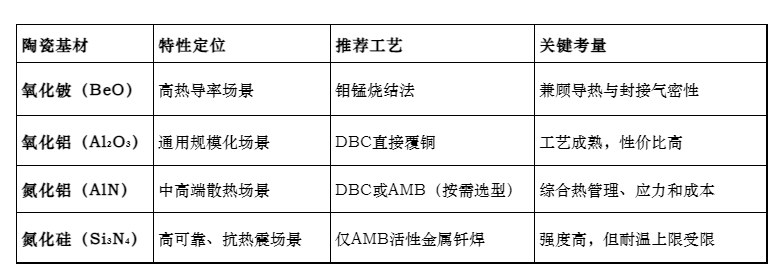
Accurate selection of the metallization process enables an optimal balance among thermal conductivity, interfacial bonding strength, high-temperature capability, and long-term operational stability—key factors in ensuring the efficient and reliable performance of advanced electronic devices and power modules.
trending news
Contact Us