



Sorry, no sales person is available right now to take your call. Pls leave a message and we will reply to you via email as soon as possible.
Home/ PCB News/ Baineng Yunban 4-layer Rigid-Flex PCB: High-Reliability Domestic Core Solution for Premium Medical Endoscope PCBs
Baineng Yunban 4-layer Rigid-Flex PCB: High-Reliability Domestic Core Solution for Premium Medical Endoscope PCBs
2026-08-10
Amid the accelerated adoption of minimally invasive diagnosis and treatment, medical endoscopes have become one of the fastest-growing categories within high-end medical equipment, with urgent demand for domestic substitution. As endoscopes continue evolving toward miniaturization, ultra-high definition, high flexibility, and enhanced stability, the inherent limitations of traditional discrete PCB solutions—comprising rigid boards, flexible circuits, and connectors—in dynamic bending, high-speed signal transmission, and long-term reliability are becoming increasingly pronounced, posing a critical bottleneck to the clinical deployment of domestically produced high-end flexible endoscopes. BaiNeng YunBoard has independently developed a 4-layer medical-grade rigid-flex integrated solution tailored to customer product requirements. From substrate selection and structural design to process control and multi-scenario clinical validation, this solution delivers compliant, mass-producible, and import-replaceable core circuitry support for high-end endoscopic devices, empowering China’s domestic high-end medical endoscopes to achieve self-reliance.
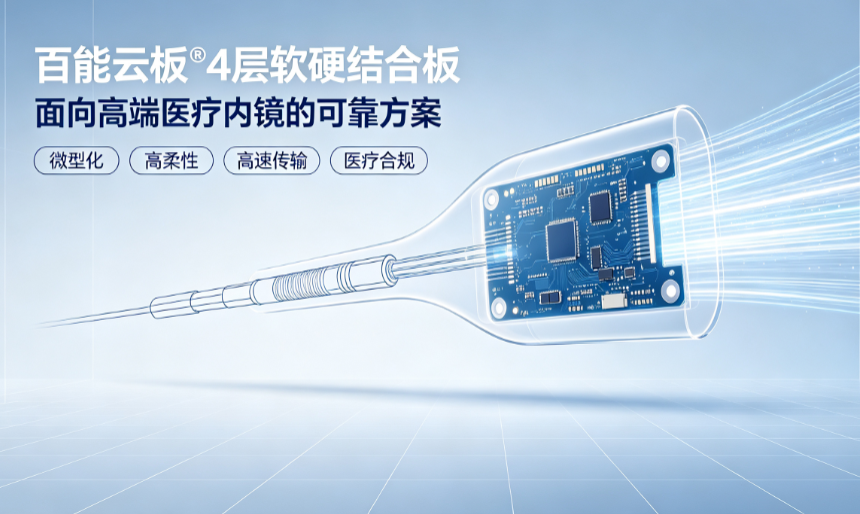
Market and Policy Dual Drivers Make Domestication of Core Endoscope Components Urgent
China’s medical endoscope market continues rapid expansion. In 2025, the domestic endoscopy system market reached $12.5 billion, projected to grow to $13.8 billion in 2026 and surpass $22 billion by 2030, with a compound annual growth rate (CAGR) of 12.5%—significantly outpacing the global average. However, domestic substitution exhibits notable “structural imbalance”: while rigid endoscope localization has reached 46%, flexible endoscopes remain below 25% due to manufacturing barriers and reliability thresholds, with core components such as circuit boards and high-speed transmission modules heavily reliant on imports. On the export front, positive signals are emerging—China’s endoscope exports totaled RMB 4.47 billion in 2025, up 32.48% year-over-year, demonstrating that domestically produced high-end endoscopes now possess international competitiveness.
Policy support is intensifying. In 2025, three national ministries jointly launched a special initiative to promote high-end medical equipment, with multiple domestic endoscopes included in the national key promotion list. The “Expert Consensus on Clinical Application Evaluation of 4K Fluorescence High-End Domestic Medical Endoscopes (2025)” explicitly states that core performance of domestic high-end endoscopes now fully matches international standards, removing policy and clinical barriers to component localization.
Meanwhile, technological advancements in endoscopy impose new challenges on PCB systems: 4K ultra-HD imaging chips demand high-speed, low-loss transmission; repeated catheter bending requires exceptional flex durability; and repeated sterilization demands extreme environmental resistance. Traditional discrete solutions suffer from persistent engineering pain points—connector detachment, signal attenuation, structural redundancy, and instability under dynamic conditions—leading to frequent intraoperative issues such as image lag, noise, or even signal loss, failing to meet the clinical demands of advanced minimally invasive surgery.
Solution Core: Integrated Rigid-Flex Architecture Systematically Solves Endoscopic Engineering Challenges
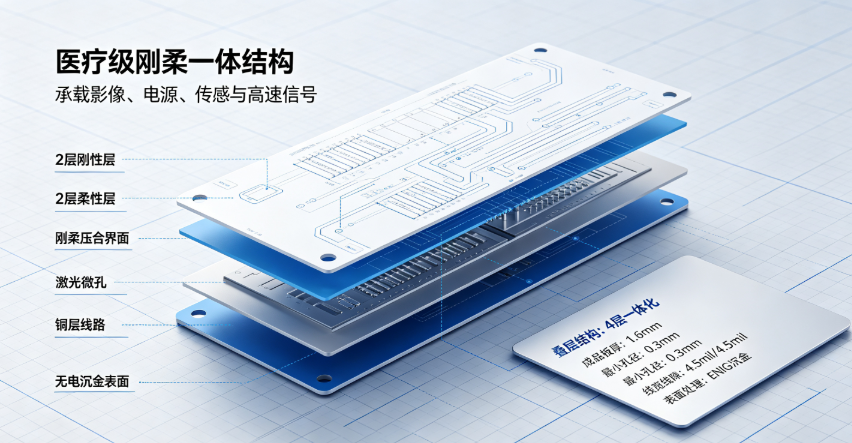
BaiNeng YunBoard’s 4-layer medical-grade rigid-flex PCB abandons traditional discrete assembly, adopting an integrated rigid-flex lamination process fully compliant with medical device regulations. Validated through multiple reliability tests, mass production trials, and multi-center clinical deployments, it fundamentally resolves structural flaws at the hardware foundation.
1. Medical-Grade Substrate System Ensures Safety and Compliance from Source
As endoscope circuit boards directly impact diagnostic safety, they demand far stricter controls on ionic contamination, thermal stability, electrical reliability, and full traceability than industrial PCBs. This solution uses ITEQ IT180F substrate (Tg ≥ 180°C) for rigid layers, offering high heat resistance, low dielectric loss, and anti-thermal deformation properties; flexible layers employ Shengyi SF305 substrate for exceptional dimensional stability; and medical-grade ultra-low ionic contamination bonding films prevent harmful ion leaching, eliminating risks of leakage or corrosion during bodily fluid contact or high-temperature/humidity conditions.
The entire manufacturing process strictly adheres to the ISO 13485 medical device quality management system and IEC 60601-1 international medical electrical safety standards. Finished products meet the highest IPC-6013 Class 3 reliability level plus medical-specific addenda. All production parameters, material batches, and test data are fully documented and archived, enabling direct submission for NMPA and FDA medical device registration without additional third-party testing—significantly shortening approval timelines.
2. Precision Process Parameters Balance Miniaturization and High Performance
Leveraging high-precision manufacturing capabilities, key specifications include:
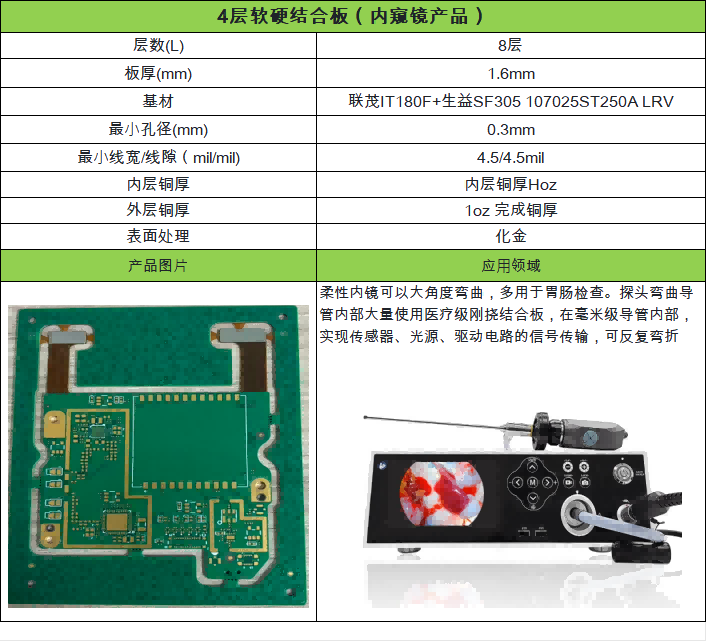
Key Performance Breakthroughs:
Seamless lamination structure completely eliminates connector loosening risks;
Ultra-thin board profile enables integration into endoscope catheters ≤6mm in diameter—in a domestic pediatric gastroscope project, probe outer diameter was reduced from 5.8mm to 5.2mm, significantly lowering trauma for young patients;
IT180F substrate withstands over three 260°C reflow cycles without delamination or warpage;SF305 flexible substrate maintains zero dimensional drift under high temperature/humidity, preventing intraoperative image distortion;
0.3mm laser micro-vias enable single-board integration of imaging, illumination, and sensing signals—in a domestic choledochoscope project, routing density increased by 40% compared to discrete solutions;
4.5mil fine traces with impedance control perfectly support MIPI 2.5Gbps/lane high-speed transmission, achieving >75% eye diagram opening with zero crosstalk or noise in 4K video;
Thick copper outer layers for stable power delivery keep voltage drop below 50mV, eliminating intraoperative light flickering;
ENIG immersion gold finish withstands 200 standard glutaraldehyde disinfection cycles, maintaining contact resistance ≤50mΩ with resistance variation <3%, fully resolving oxidation failure issues seen with OSP finishes after repeated sterilization.
Compliance Enablement Example: A Shenzhen-based endoscope startup leveraged this solution’s complete DFM analysis, impedance testing, X-ray inspection, and ionic contamination reports to reduce PCB-related registration correction time from 8 weeks to just 2 weeks, dramatically accelerating time-to-market.
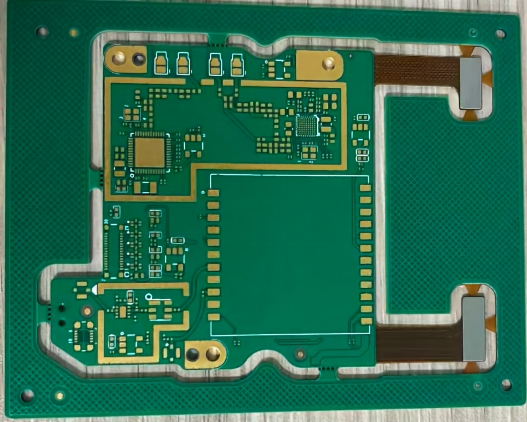
BaiNeng YunBoard 4-Layer Medical Rigid-Flex PCB for Endoscopes
3D Structural Innovation: Simultaneous Achievement of Miniaturization, Bend Durability, and High-Speed Transmission
Unlike discrete solutions with inherent structural flaws, the integrated lamination design enables seamless transition between rigid and flexible zones with uniform stress distribution, specifically addressing three core challenges.
High Bend Durability: Flexible sections withstand >12,000 cycles of repeated bending at 5mm radius and 1Hz frequency without fracture or delamination, with impedance variation ≤±5%. A gastroscope equipped with this solution at a Guangzhou tertiary hospital accumulated over 400 bends per procedure, achieving bit error rates <1×10⁻¹²; the device operated reliably for 28 months without signal failure—far exceeding the industry norm where imported discrete solutions typically develop contact issues after just 18 months.
Extreme Space Efficiency: Rigid zones concentrate active components, while flexible segments measure <0.4mm thick, conforming tightly to catheter walls. In a domestic ultra-slim transnasal gastroscope project, probe outer diameter was reduced to 4.9mm (vs. industry standard 5.4mm), lowering patient VAS pain scores from 5.2 to 3.1 and significantly improving procedural comfort. Overall circuit footprint is only 60% of discrete solutions, leaving ample room for multifunctional integration.
Stable High-Speed Transmission: The integrated architecture simultaneously supports HD imaging power, 300mA+ illumination drive, 2.5Gbps/lane video transmission, and multi-channel sensing—eliminating crosstalk entirely. Full-load testing by an East China endoscope manufacturer showed zero frame drops and zero errors after 200 hours of continuous operation under dynamic bending, with image latency consistently controlled within 33ms—fully meeting real-time imaging requirements for precision minimally invasive surgery.
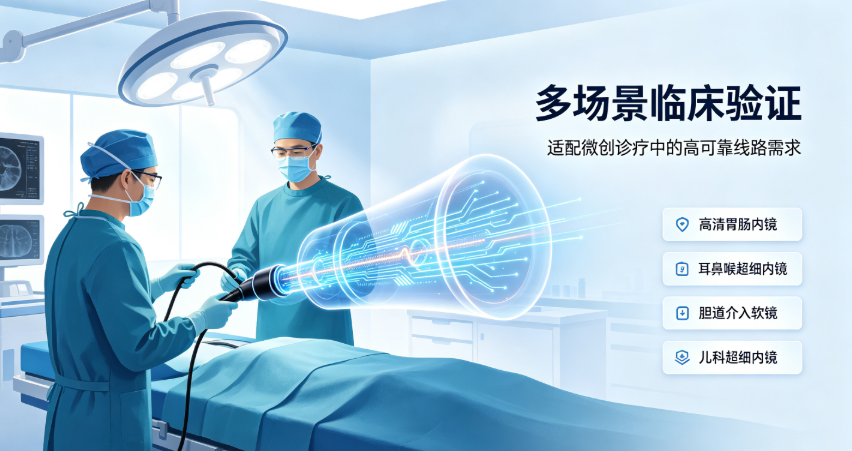
Multi-Center Clinical Validation: Comprehensive Deployment Across Five Core Scenarios
This solution is now mass-produced for over ten leading domestic endoscope manufacturers, covering gastrointestinal, ENT, biliary, urological, and pediatric minimally invasive applications, with cumulative installations exceeding 8,000 units. Real-world clinical performance confirms stability and full compatibility as a drop-in replacement for imported counterparts.
HD Gastrointestinal Endoscopes: A Shandong tertiary hospital completed over 6,000 GI procedures by July 2026 with zero image anomalies or signal interruptions; image clarity and color fidelity matched imported high-end devices. The integrated design simplified assembly, reducing total device cost by 40% and enabling high-value domestic substitution.
Ultra-Slim ENT Endoscopes: A Shanghai ENT specialty hospital adopted 2.7mm ultra-slim otoscopes with highly flexible, bendable tips providing unobstructed views, reducing average procedure time by 12 minutes and significantly enhancing surgical efficiency.
Biliary/Urological Interventional Endoscopes: Data from a Beijing tertiary hospital’s urology department showed peak bending angles reaching 280°, with over 200 bends per procedure and stable 4K output throughout. After 60 glutaraldehyde disinfection cycles, insulation resistance remained >100MΩ, with no electrical or structural degradation—meeting high-frequency reuse demands.
Pediatric Ultra-Slim Endoscopes: Chongqing Children’s Hospital used 5.0mm ultra-slim gastroscopes in an 82-case, 6-month trial involving low-weight pediatric patients, achieving a 100% intubation success rate; post-procedure adverse events decreased by 28% versus imported devices, offering gentler, safer hardware for pediatric minimally invasive care.
Additionally, this solution flexibly adapts to portable imaging handles, minimally invasive sensor catheters, and other precision medical devices, expanding its applicability across high-end medical equipment categories.
Authoritative Test Data: Fully Quantified, Reliable, and Traceable
Rigorous testing by third-party authorities and in-house labs confirms all core metrics exceed medical standards:
| Test Item | Test Result | Test Conditions |
|---|---|---|
| Bend Fatigue Life | >12,000 cycles without fracture/delamination; impedance change <±5% | R=5mm, 1Hz |
| High-Speed Signal BER | <1×10⁻¹² | MIPI 2.5Gbps, dynamic bending |
| Ionic Contamination | ≤0.5μg NaCl eq./cm² (medical limit ≤1.0) | IPC-TM-650 2.3.28 |
| Insulation Resistance after Damp Heat | ≥100MΩ | 40℃/93%RH/96h, DC 100V |
| Reflow Soldering Resistance | ≥3 cycles (260℃±5℃) without delamination/bubbling | Peak 260℃ |
| Disinfection Cycle Tolerance | ≥200 cycles; contact resistance variation <5% | 2% glutaraldehyde soak, 10min/cycle |
Mass Production & Delivery: Class-10,000 Cleanroom Line, Lean, Compliant, and Traceable
BaiNeng YunBoard operates a dedicated Class-10,000 cleanroom medical PCB production line, with strict segregation between medical and industrial production zones, ensuring batch consistency and clinical-grade reliability through full-process medical compliance.
R&D Phase: Free medical-specific DFM reviews proactively address signal integrity, stress concentration, and impedance matching issues. One Hangzhou endoscope company shortened its development cycle by 40%, achieving first-article approval just 21 days after schematic finalization.
Mass Production Control: Enforces “Three Unified Quality Standards” (consistent substrates, equipment, and process parameters), maintaining batch yield above 98.5% and dimensional precision CPK >1.67—meeting top-tier medical equipment standards.
Full-Chain Traceability: All process data is encrypted and archived, supporting 10-year full-chain traceability—fully compliant with NMPA requirements and accompanied by complete test documentation to accelerate certification.
Flexible Customization: Adjustable parameters include flexible segment length, copper thickness, gold thickness, and differential impedance—to meet diverse high-end endoscope R&D needs.
Conclusion and Outlook
As the “central nervous system” of endoscopic devices, PCBs directly determine imaging quality, operational stability, and clinical safety. Traditional discrete solutions and industrial-grade materials can no longer support the evolution of high-end endoscopes. BaiNeng YunBoard’s 4-layer medical rigid-flex PCB delivers five core advantages—medical-grade substrates, integrated architecture, precision manufacturing, clinical validation, and compliant mass production—precisely addressing critical pain points in miniaturization, high-flex durability, high-speed transmission, sterilization resistance, and stability.
Already deployed across multiple scenarios at scale, this solution matches imported counterparts in overall performance, offering high cost-effectiveness, short registration cycles, flexible customization, and exceptional mass-production stability—effectively closing the domestic gap in core PCBs for high-end flexible endoscopes. Looking ahead, BaiNeng YunBoard will continue deepening its expertise in precision medical PCBs, advancing both technology and compliance frameworks to accelerate domestic substitution and global expansion of China’s minimally invasive medical equipment.
We sincerely invite industry partners to engage in deep technical co-creation and project collaboration, jointly advancing the new era of autonomous, controllable high-end medical equipment.
trending news
Contact Us