



Sorry, no sales person is available right now to take your call. Pls leave a message and we will reply to you via email as soon as possible.
Home/ PCB News/ TLX-8 High-Frequency PCB Laminate Core Advantages Analysis: Material Selection Logic Exclusive to RF/Microwave Engineers
TLX-8 High-Frequency PCB Laminate Core Advantages Analysis: Material Selection Logic Exclusive to RF/Microwave Engineers
2026-07-31
In the R&D and mass production of RF, radar, and millimeter-wave PCBs, a widespread yet dangerous misconception has long persisted: treating all high-frequency laminates as interchangeable and assuming their performance is universally compatible. In reality, when projects advance into high-end microwave and millimeter-wave stages, most engineers and procurement personnel—though aware that high-frequency substrates are required—struggle to clearly distinguish the fundamental differences among the three major material systems: PTFE (polytetrafluoroethylene), hydrocarbon resin, and standard FR4. Blind substitution of laminates is precisely the root cause of signal distortion, test failures, and low mass-production yields.
With the large-scale deployment of 5G-A millimeter-wave, automotive radar, satellite communications, and military microwave equipment, AGC Taconic’s TLX-8—a classic high-end microwave substrate—has become the preferred material in cutting-edge RF solutions. However, most industry practitioners only recognize its name, lacking systematic understanding of its applicable scenarios, process characteristics, performance limitations, and substitution restrictions.
Drawing on Kingboard Group’s over two decades of hands-on experience in high-frequency PCB mass production, this article systematically dissects the core performance, process essentials, application boundaries, and underlying material selection logic of TLX-8, empowering engineers to accurately avoid pitfalls in material selection and mass production, and truly overcome the challenges of high-end RF PCB material specification.
I. Material Positioning: Grade and Industry Standing of TLX-8
TLX-8 belongs to AGC Taconic’s (Taconic) glass-fiber-reinforced PTFE microwave high-frequency laminate family and is part of the industry-standard TLX series (including TLX-0, TLX-9, TLX-8, TLX-7, TLX-6). It is widely recognized as the benchmark commercial precision substrate for RF, microwave, and even millimeter-wave applications and is extensively used in mass-produced high-end RF PCBs.
From a materials perspective, TLX-8 is fundamentally distinct from mainstream hydrocarbon resin high-frequency laminates and modified FR4 high-frequency boards. Built on a pure PTFE base, it emphasizes ultra-low loss and high electrical stability across wide temperature ranges, specifically engineered for high-precision RF applications—not as a general-purpose high-frequency laminate.
A critical misconception requiring correction:
Some engineers and procurement staff habitually compare or even substitute TLX-8 with hydrocarbon resin laminates like S7136H—this practice is strictly prohibited. The two materials differ entirely in composition, process compatibility, and application scenarios, and are not interchangeable. Numerous mass production projects have repeatedly confirmed: blind substitution directly leads to RF performance exceeding specifications and a sharp drop in batch yield.
TLX-8: Pure PTFE-based, ultra-low loss, optimized for single-layer and double-layer precision microwave RF boards;
S7136H: Hydrocarbon resin-based, supports multi-layer lamination and hybrid stack-ups, suitable for high-layer-count high-frequency/high-speed board mass production.
II. Core Parameter Analysis: TLX-8’s Technical Strength in High-End RF Applications
The quality of high-frequency laminates hinges primarily on dielectric constant (Dk) and dissipation factor (Df), which directly determine the integrity and stability of high-frequency signal transmission. Among comparable PTFE-based materials, TLX-8 demonstrates exceptional parameter consistency and environmental stability (tested at 10 GHz), meeting the stringent demands of millimeter-wave and military RF applications.
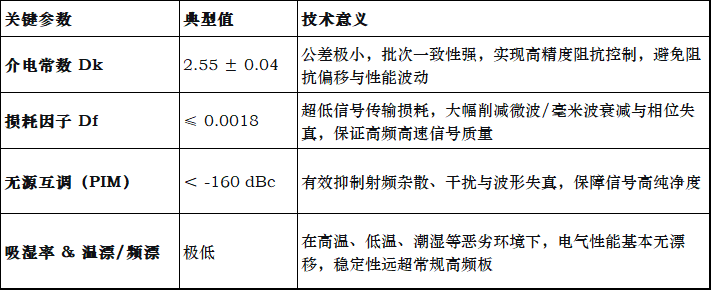
In short: The higher the operating frequency and the harsher the operating conditions, the more pronounced TLX-8’s performance advantages become—advantages unattainable by standard FR4 or conventional hydrocarbon laminates.
III. Five Core Characteristics: TLX-8’s Suitability for High-Precision RF Applications
1. Ultra-Low Loss, Optimized for Millimeter-Wave High-Frequency Scenarios
Pure PTFE inherently offers low-loss physical properties, fundamentally reducing high-frequency signal transmission loss. This effectively addresses common issues in millimeter-wave and microwave devices—such as signal attenuation, phase shift, and transmission distortion—making it the preferred substrate for high-end civilian and military-grade microwave/millimeter-wave equipment.
2. Glass-Fiber Reinforcement Compensates for Inherent PTFE Weaknesses
Traditional pure PTFE is relatively soft, lacks mechanical strength, and exhibits poor creep resistance, making it prone to deformation during processing and structural failure under vibration or thermal cycling during long-term use. TLX-8 employs a glass-fiber-reinforced composite structure, significantly enhancing mechanical strength, flatness, and structural stability. This enables reliable performance under complex conditions such as vibration and extreme temperature variations, balancing excellent electrical performance with long-term reliability.
3. Clear Process Boundaries: Suitable for Low-Layer Boards, Not for High-Layer Lamination
This is the most critical—and often overlooked—aspect in material selection. Due to inherent material constraints, TLX-8 is only suitable for single-layer, double-layer, and limited-layer RF boards; it does not support multi-layer lamination and must never be hybrid-laminated with FR4 in mass production. Forcing high-layer-count constructions frequently causes delamination, warpage, voids in via walls, and layer misalignment—severely compromising yield. Professional high-frequency PCB manufacturers strictly adhere to these boundaries, mitigating structural risks at the design stage.
4. Military-Grade Reliability for Extreme Operating Conditions
TLX-8 achieves UL94 V-0 flammability rating and features low outgassing, radiation resistance, high-temperature tolerance, creep resistance, and aging resistance. It ensures long-term stable operation in aerospace, military radar, outdoor base stations, and automotive high-frequency equipment, fully complying with reliability certification standards for military and high-end industrial products.
5. Extremely High Process Threshold, Requiring Specialized High-Frequency Manufacturing Expertise
PTFE’s physicochemical properties differ drastically from FR4 and hydrocarbon resins. Drilling, through-hole metallization, plating, etching, and surface finishing all require customized process parameters. Any deviation can lead to rough hole walls, poor copper adhesion, open circuits, or signal anomalies. Consequently, TLX-8 places exceptionally high demands on a PCB manufacturer’s high-frequency process capabilities and quality control systems. BaiNeng YunBan has specifically built a dedicated PTFE high-frequency production line with mature, comprehensive process parameters, ensuring consistent yield and performance from prototyping to mass production, and rigorously safeguarding RF performance.
IV. Precise Application Scenarios: When TLX-8 Is Mandatory
Based on years of mass production experience, TLX-8 is not a general-purpose high-frequency laminate and is unsuitable for standard multi-layer high-frequency/high-speed projects. Instead, it precisely targets niche segments in high-precision microwave RF applications. The following scenarios require priority selection and strictly prohibit arbitrary substitution—this is the core service domain of high-end precision high-frequency PCBs:
5G-A / 6G millimeter-wave antennas, array antennas, and high-frequency RF antenna elements
Military microwave radar, automotive high-precision perception radar, and detection radar systems
Precision passive RF components such as RF filters, power dividers, couplers, and circulators
Microwave test instruments and precision signal transmission/test equipment
Satellite communications and aerospace high-end passive RF modules
Selection Conclusion: For any single-layer or double-layer microwave RF project demanding ultimate signal purity, ultra-low interference, and high environmental stability, TLX-8 should be the primary choice.
V. In-Depth Material Comparison: TLX-8 vs. Conventional High-Frequency Laminates
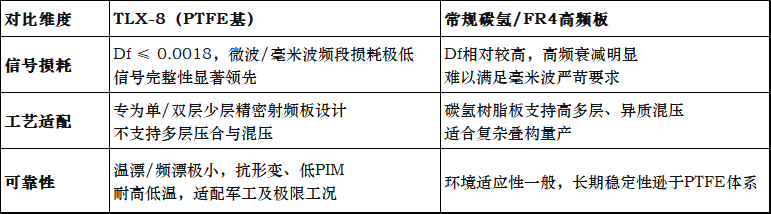
Key Insight: This is not a matter of superiority but of scenario-specific complementarity. The industry must match materials precisely based on layer count, operating frequency, and production requirements—hydrocarbon resin laminates for high-layer-count high-frequency/high-speed and hybrid stack-up projects; TLX-8 for single/double-layer precision microwave RF and high-reliability applications. Blind substitution between the two is absolutely unacceptable.
VI. Industry Summary on Core Material Selection Principles
Many high-frequency projects suffer from test failures, signal instability, and low mass-production yields—not due to design flaws, but to initial material misselection and process-scenario mismatches.
The core principle of high-frequency PCB material selection has never been “more expensive is better,” but rather precise matching and needs-based selection:
High-layer-count high-frequency/high-speed and hybrid stack-up mass production → Hydrocarbon resin high-frequency laminates
Single/double-layer microwave RF, millimeter-wave precision, and high-reliability projects → TLX-8
Only by precisely aligning material performance with process requirements can projects achieve first-pass testing success and stable mass production, proactively avoiding material selection and manufacturing risks.
If you have radar, antenna, or microwave RF-related projects and are uncertain about material selection or process strategies—or concerned about mass-production yield and signal performance—please contact BaiNeng YunBan. We offer free one-on-one design reviews to help you accurately avoid pitfalls and steadily advance your high-end RF projects.
trending news
Contact Us