


Sorry, no sales person is available right now to take your call. Pls leave a message and we will reply to you via email as soon as possible.
Home/ PCB News/ Ultimate Craftsmanship Empowers Computing Infrastructure: BaiNeng YunBan Unveils New 14-Layer, 4-Stack HDI Server Power PCB
Ultimate Craftsmanship Empowers Computing Infrastructure: BaiNeng YunBan Unveils New 14-Layer, 4-Stack HDI Server Power PCB
2026-04-23
Against the backdrop of rapid evolution in the digital economy, data centers and high-end servers—serving as core carriers of computing infrastructure—are facing multiple challenges, including continuously rising computing density, heightened demands for operational efficiency, and increasingly stringent system reliability requirements. As the "heart" ensuring stable equipment operation, the power supply module's core component—the PCB—directly determines the integration level, stability, and service life of the power delivery system. To address these demands, BaiNeng YunBan officially launches its 14-layer, 4-stack HDI server power supply module PCB. Leveraging the company’s profound technical expertise in PCB manufacturing and end-to-end quality control capabilities, this product integrates industry-leading fabrication processes, high-performance material systems, and scenario-specific customized designs to deliver a highly reliable, efficient, and adaptable core power solution for next-generation computing equipment—fully demonstrating BaiNeng YunBan’s technological strength and innovative heritage as a premium PCB manufacturer.
1. Advanced HDI Process Breakthrough: BaiNeng YunBan Sets a New Benchmark for Precision Interconnectivity
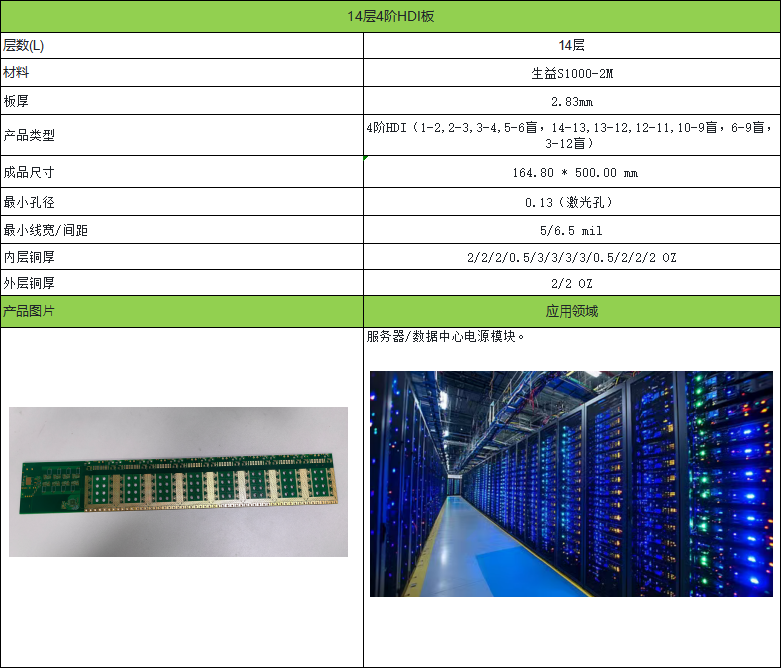
As a flagship offering in BaiNeng YunBan’s high-end PCB portfolio, this product features a 14-layer, 4-stack HDI stacked via structure, establishing a complex interconnect network comprising “blind vias from layers 1-2, 2-3, 3-4, 5-6 + blind vias from layers 14-13, 13-12, 12-11, 10-9 + blind via from layer 6-9 + through-hole from layer 3-12.” This architecture precisely meets the multi-power-layer and multi-signal-layer routing requirements of server power modules, surpassing traditional PCB routing limitations and enabling a leapfrog upgrade in high-density interconnectivity.
1. Micron-Level Precision Manufacturing Enables Ultimate Routing Density
Leveraging industry-leading UV laser drilling equipment and years of precision manufacturing experience, BaiNeng YunBan achieves an ultra-small laser-drilled via diameter of 0.13 mm, paired with fine trace/space dimensions of 5/6.5 mil (approximately 0.127/0.165 mm). Within a finished board size of 164.80 mm × 500.00 mm, the design efficiently accommodates over 1,200 vias and complex routing layouts, achieving a routing density more than 30% higher than conventional PCBs. This process breakthrough fully satisfies the miniaturization and space-efficiency requirements of high-integration power modules, providing ample room for internal equipment optimization.
2. Precise Lamination Control Ensures Interconnect Reliability
Drawing on extensive experience in advanced HDI manufacturing and a comprehensive quality control system, BaiNeng YunBan overcomes the industry-wide challenge of cumulative alignment tolerance in multi-layer stacked vias through precise process control across sequential lamination and laser drilling steps. Interlayer alignment accuracy is strictly maintained within ±25 μm. Every unit undergoes 100% flying probe testing to eliminate potential risks such as opens or shorts, upholding the company’s integrated “Material–Process–Inspection” quality standard and establishing a robust physical foundation for stable, high-efficiency power signal transmission.
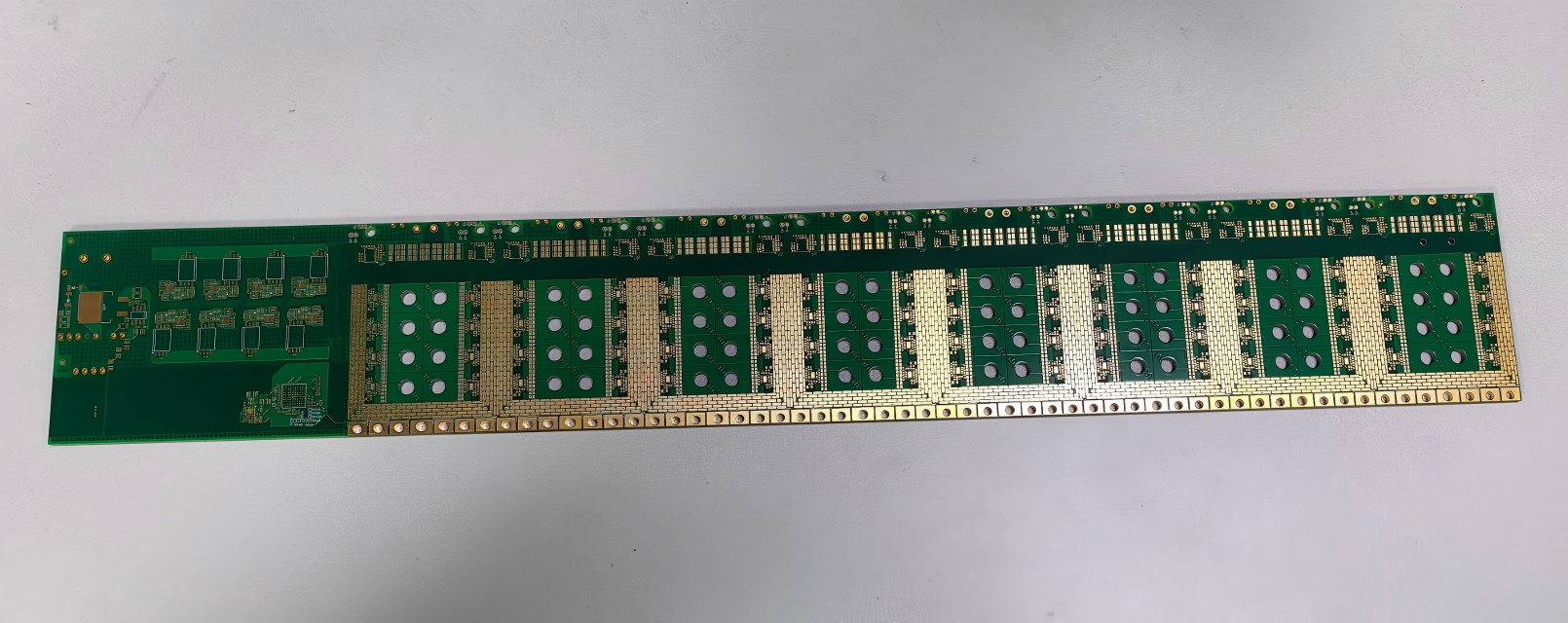
BaiNeng YunBan 14-Layer, 4-Stack HDI Product Image
2. High-Performance Material System: BaiNeng YunBan Establishes a Foundation for Highly Reliable Operation
To meet the demanding operating conditions of server power modules—including 24/7 continuous operation, high-temperature/high-load environments, and complex deployment scenarios—BaiNeng YunBan selects Shengyi S1000-2M high-thermal-resistance substrate material combined with customized copper thickness designs to build a material system characterized by high stability, long lifespan, and strong EMI resistance.
1. High Thermal Resistance and Dimensional Stability for Extreme Conditions
The Shengyi S1000-2M substrate boasts a glass transition temperature (Tg) as high as 180°C and a low Z-axis coefficient of thermal expansion (CTE) of just 2.8%. During thermal cycling tests from -55°C to 125°C, board warpage is strictly controlled within 0.1%, effectively suppressing deformation under high temperatures. This ensures structural integrity of vias and traces during lead-free reflow soldering and prolonged thermal stress exposure.
2. Corrosion and Moisture Resistance Extends Service Life
The material exhibits excellent resistance to Conductive Anodic Filament (CAF) formation. After 1,000 hours of rigorous testing under 85°C/85% RH conditions, no insulation failure occurs. Combined with a low moisture absorption rate of ≤0.2%, it effectively resists electrochemical corrosion in complex environments such as data centers and industrial sites, preventing ion migration-induced insulation failures and significantly extending product lifespan while reducing maintenance costs.
3. Customized Copper Thickness Balances Performance and Efficiency
Tailored to the core requirements of server power modules, BaiNeng YunBan implements a differentiated copper thickness configuration: inner layers at 2/2/2/0.5/3/3/3/3/0.5/2/2/2 oz, and outer layers at 2/2 oz. Power planes utilize 3 oz thick copper, enabling effortless handling of up to 40 A per channel with voltage drop controlled within 5 mV—effectively minimizing impedance and energy loss along power paths. Signal layers balance ±10% impedance control with high routing density, achieving optimal performance equilibrium between power and signal transmission.
3. Deep Multi-Scenario Adaptation: BaiNeng YunBan Empowers Computing Infrastructure Across All Domains
Built upon advanced HDI processes and high-performance materials, this product is deeply optimized for diverse high-end computing scenarios, precisely addressing power delivery challenges across applications and providing stable, efficient, and reliable core support for next-generation computing infrastructure.
1. High-Density Rack-Mounted Server Power Modules
Pain Point: Blade servers and high-density rack-mounted systems feature extremely compact internal spaces (typically ≤200 mm × 600 mm per power module), requiring simultaneous power delivery to CPUs, GPUs, memory, and other components. Power fluctuations can directly cause compute throttling, data loss, or even system crashes.
Solution: Utilizing 4-stack HDI interconnect technology, the design achieves ultra-high-density routing within a constrained 164.80 mm × 500.00 mm footprint, integrating 12 independent power rails, 24 monitoring signals, and 4 high-speed communication interfaces—boosting routing density by over 30% and saving approximately 25% installation space compared to conventional PCBs. Combined with low-impedance, high-current design, power ripple is stably maintained at ≤20 mV (surpassing the industry standard of 30 mV).
Value Delivered: Successfully deployed in high-density rack-mounted server projects by a leading domestic server manufacturer. After three months of continuous full-load testing, the solution achieved zero failures, helping the customer increase data center computing density by 40% and reduce O&M costs by 20%.
2. Centralized Power Systems in Large-Scale Data Centers
Pain Point: In centralized power architectures of hyperscale data centers (with >1,000 servers per facility), PDUs and power backplanes must handle total currents exceeding 200 A. Enclosed environments and intense heat loads place extreme demands on PCB current-carrying capacity and thermal performance.
Solution: Featuring 3 oz thick copper power planes, each module supports up to 200 A total current, reducing line losses by over 15% (saving more than ¥100,000 annually in electricity costs per large data center). Combined with a standard board thickness of 2.83 mm and high thermal conductivity substrate properties, board surface temperature remains below 85°C under full load, effectively mitigating heat accumulation. The design fully supports N+1 redundant power architectures, achieving ≥1 million hours of mean time between failures (MTBF) and supporting the industry’s top-tier availability standard of 99.999% (≤5 minutes annual downtime).
Value Delivered: Mass-deployed in a hyperscale data center in Eastern China. After six months of real-world operation, power stability reached 100%, with line losses reduced by 18% compared to legacy solutions.
3. Power Modules for High-End AI Servers and Accelerator Cards
Pain Point: In AI large-model training and inference scenarios, single-card power consumption exceeds 1 kW, with individual high-end AI training servers drawing 5–8 kW. Instantaneous power fluctuations on AI chips are 3–5 times greater than those in conventional servers; delayed dynamic response from power supplies severely impacts model training efficiency and inference accuracy.
Solution: Employing a multi-plane power architecture supporting 8-phase parallel output, each channel delivers up to 40 A with dynamic response time ≤10 μs. Ripple suppression capability exceeds 60 dB, providing AI accelerators and GPU clusters with precise, stable dynamic power. After 1,000 hours of continuous operation at 80% load, performance degradation is ≤2% (far surpassing the industry benchmark of 5%). When integrated with liquid cooling systems, power module thermal efficiency improves by 30%.
Value Delivered: Deployed in a domestic AI tech company’s computing center to support trillion-parameter model training. After four months of uninterrupted operation, zero failures occurred, and computing output stability improved by 25%.
4. Industrial-Grade Server and Edge Computing Node Power Modules
Pain Point: Edge computing nodes, industrial servers, and telecom base stations are often deployed in harsh environments such as outdoor cabinets and factory floors, facing wide temperature ranges (-40°C to 85°C), dust, vibration, and electromagnetic interference. Vibration can cause trace delamination or via fractures, while high humidity promotes electrochemical corrosion—all leading to extremely high maintenance costs.
Solution: Utilizing Shengyi S1000-2M high-reliability substrate, insulation resistance remains ≥10¹⁰ Ω across -40°C to 85°C, ensuring stable performance. The design passes IEC 60068-2-27 vibration and shock tests (amplitude ≤0.35 mm, acceleration ≤15 g), demonstrating exceptional mechanical strength and meeting the ≥10-year service life requirement for industrial deployments.
Value Delivered: Widely adopted in smart factories, intelligent power grids, vehicular edge computing, and 5G base stations. In an outdoor 5G base station project, the solution operated fault-free with zero performance degradation after one year in harsh conditions, ensuring uninterrupted communication.
Conclusion
The official launch of BaiNeng YunBan’s 14-layer, 4-stack HDI server power supply module PCB marks a milestone achievement in the company’s commitment to advancing computing infrastructure through technological innovation and uncompromising quality. With nearly three decades of industry expertise and an integrated “Material–Process–Inspection” quality system, every detail—from 0.13 mm laser micro-vias to precise 14-layer lamination, from rigorous selection of Shengyi high-thermal-resistance substrates to scientifically optimized copper thickness—reflects BaiNeng YunBan’s relentless pursuit of ultimate craftsmanship and reliability. Every performance metric validates the product’s robust capabilities.
Looking ahead, BaiNeng YunBan will continue deepening its expertise in high-end PCB manufacturing, focusing on evolving demands in computing infrastructure, artificial intelligence, and industrial internet. By persistently breaking through technical barriers and optimizing product performance, the company remains steadfast in its core mission: “Solving the toughest challenges in high-precision, high-complexity, and high-layer-count PCB orders.” BaiNeng YunBan is committed to delivering superior, application-optimized, and highly reliable PCB solutions to global customers—empowering high-quality development of the digital economy and accelerating the construction of next-generation computing infrastructure to new heights.
trending news
Contact Us