


Sorry, no sales person is available right now to take your call. Pls leave a message and we will reply to you via email as soon as possible.
Home/ PCB News/ Baineng Yunban 6-Layer Embedded Copper Block PCB: A Benchmark Solution for Thermal Management and Current-Carrying Performance in High-Power Applications
Baineng Yunban 6-Layer Embedded Copper Block PCB: A Benchmark Solution for Thermal Management and Current-Carrying Performance in High-Power Applications
2026-04-29
In high-power-density application scenarios such as new energy vehicles, industrial IGBTs, and high-compute servers, the thermal management capability, current-carrying performance, and long-term reliability of PCBs directly determine system stability and service life. BaiNeng YunBan’s 6-layer embedded copper block PCB leverages integrated embedded copper technology, advanced HDI structures, and highly stable base materials to deliver a comprehensive solution that combines efficient heat dissipation, high-current handling, and highly reliable interconnectivity—providing robust hardware support for power electronics operating under demanding conditions.
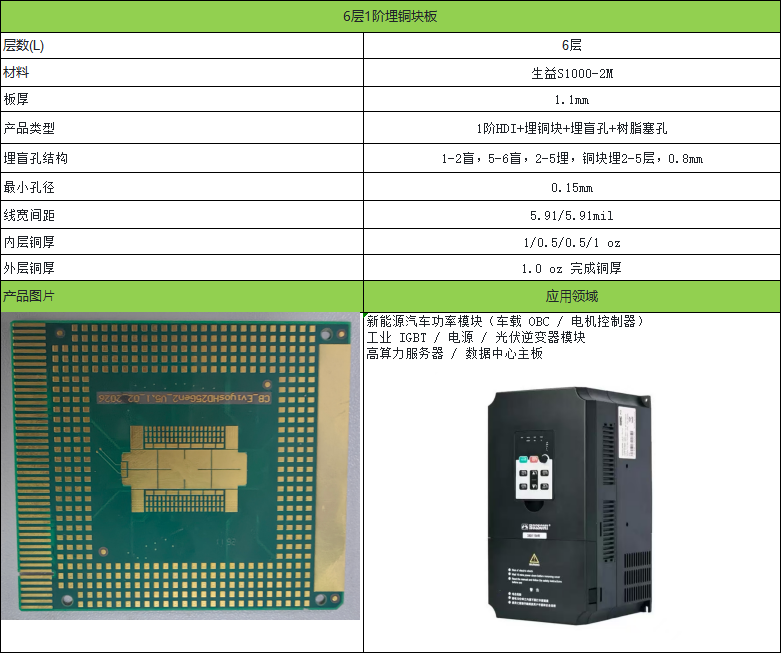
Core Processes and Specifications: A Technical Architecture Customized for High-Power Applications
All specifications of this PCB are designed around the three core requirements of “high power, high thermal conductivity, and high reliability,” achieving deep integration between process technology and performance:
Core Technological Breakthroughs: Embedded Copper Block Technology Addresses Key Challenges in High-Power PCBs
Traditional PCBs face three major challenges in high-power-density applications: thermal runaway risks due to excessive thermal resistance, current-carrying bottlenecks caused by the skin effect, and reliability failures triggered by CTE (Coefficient of Thermal Expansion) mismatch. Through fundamental architectural innovation with its embedded copper block technology, BaiNeng YunBan systematically resolves these issues:
1. Vertical Thermal Conduction Architecture Overcomes Local Heat Flux Density Bottlenecks
Conventional via-based cooling solutions offer vertical thermal conductivity of only 10–20 W/(m·K), which is insufficient for power devices (e.g., IGBTs, MOSFETs) generating localized heat flux densities exceeding 100 W/cm². BaiNeng YunBan’s integrated embedded copper block process creates high-conductivity copper thermal pillars inside the PCB (thermal conductivity ≈ 400 W/(m·K)), enabling direct heat transfer from the heat source layer to multi-layer heat-spreading copper foils. This reduces vertical thermal resistance by over 40%, effectively maintaining hotspot temperatures beneath components within safe limits and eliminating risks of thermal runaway and thermal fatigue failure.
2. Low-Impedance Current Paths Suppress Skin Effect and Joule Heating Losses
To address the insufficient effective conductive cross-section caused by the skin effect in high-frequency, high-power circuits, the embedded copper block provides a low-impedance current path far superior to conventional traces, capable of continuously carrying currents in the hundreds of amperes. Combined with 1 oz thick outer-layer copper foil, this design significantly reduces AC skin effect losses. Compared to pure copper foil routing, the embedded copper block lowers DC loop resistance by over 60%, substantially reducing Joule heating and improving power module conversion efficiency.
3. Embedded Integration Design Optimizes System Power Density
The embedded copper block is integrated between layers and co-formed with the PCB substrate, requiring no additional external space and not interfering with surface component placement or BGA fan-out routing. This design eliminates the need for external heat sinks, thermal pads, and other redundant structures typically required in conventional solutions—enabling device miniaturization and weight reduction without compromising thermal performance. It is especially suitable for space-constrained applications such as new energy vehicle controllers and industrial inverters.
4. Optimized CTE Match Enhances Long-Term Reliability Under Thermal Cycling
The embedded copper block features precise CTE matching with Shengyi S1000-2M substrate material, effectively mitigating shear stress generated during thermal cycling due to CTE mismatch. This prevents common failure modes in traditional designs, such as via wall cracks, substrate delamination, and copper foil peeling. Combined with 1-step HDI buried/blind vias and resin-filled via processes, it further eliminates risks of voids and plating inclusions in blind vias, ensuring insulation reliability and mechanical stability under high-voltage, high-load conditions.
Versatile Application Scenarios: Real-World Implementations Across Three High-Power Domains
Thanks to its customized process design and stringent quality control, BaiNeng YunBan’s embedded copper block PCB has achieved mass production across multiple high-reliability industries, precisely addressing real customer pain points. Implementation results are quantifiable and traceable, earning strong recognition from industry-leading clients.
New Energy Vehicle Power Module (On-Board Charger – OBC)
Customer & Scenario: On-board charger (OBC) project for a mainstream Chinese NEV manufacturer’s all-electric SUV, requiring 22kW fast charging within a compact installation space (≤280mm × 180mm × 60mm), compliance with automotive-grade thermal cycling standards (-40°C to 125°C), and a maximum device junction temperature below 150°C.
Original Pain Points: The customer used a conventional aluminum-core PCB + heat sink combination. During fast charging, the power MOSFET (model: IPB65R110CFD) reached a junction temperature of 178°C—far exceeding the safety threshold—frequently triggering overheating protection and interrupting fast charging. The 12mm-thick heat sink consumed significant space, failing to meet compactness requirements.
Solution & Results: BaiNeng YunBan’s 6-layer embedded copper block PCB was adopted, with a custom 0.8mm copper block embedded directly beneath the MOSFET leads to create a vertical thermal conduction path. This reduced the MOSFET junction temperature from 178°C to 153°C during fast charging—fully compliant with automotive safety standards—and eliminated fast-charging interruptions. The 12mm heat sink was replaced with a 3mm thin thermal pad, reducing overall PCB thickness from 8.2mm to 5.7mm (30% volume reduction), perfectly fitting the tight vehicle space. The solution has been mass-produced, with over 120,000 units delivered. After 1,000 automotive-grade thermal cycles (-40°C to 125°C, 1 hour per cycle), no delamination, via cracking, or copper peeling occurred, with yield consistently above 99.8%, enabling the customer’s vehicle model to successfully pass NEV certification.
Industrial Power Electronics (11kW Motor Drive Module)
Customer & Scenario: A leading Chinese industrial inverter manufacturer deploying an 11kW motor drive module in mining machinery and production lines, requiring continuous operation under dusty, high-temperature (up to 65°C ambient), and high-vibration (10–50Hz) conditions. The IGBT module (model: FF300R12KT4) must maintain a long-term operating temperature ≤120°C, with a Mean Time Between Failures (MTBF) ≥20,000 hours.
Original Pain Points: The standard 6-layer PCB lacked embedded copper structures, causing IGBT hotspot temperatures to reach 142°C and line voltage drop ≥0.8V. This led to frequent IGBT burnout and signal anomalies, with a failure rate as high as 8.3%, severely impacting reputation and after-sales costs.
Solution & Results: BaiNeng YunBan’s embedded copper block PCB was implemented, with 0.8mm copper blocks embedded in layers 2–5 beneath the IGBT mounting area and optimized copper thickness distribution to enhance current capacity. This reduced the IGBT hotspot temperature from 142°C to 115°C—below the safety threshold—and lowered line voltage drop to under 0.5V, reducing Joule heating. Motor drive efficiency improved from 94.2% to 96.7%. CTE-matched materials and resin-filled vias significantly enhanced vibration resistance, making the PCB suitable for mining equipment. After mass deployment, failure rates dropped to 1.7%, and MTBF increased to 28,000 hours—well exceeding requirements. External auxiliary cooling structures were eliminated, reducing unit cost by 8% and saving the customer over RMB 3 million annually in manufacturing and after-sales expenses.
High-Compute Servers/Data Center Motherboards (AI Server Power Delivery Module)
Customer & Scenario: A leading Chinese data center solutions provider using AI servers for AI training and big data processing. The power delivery module must stably supply power to CPUs (Intel Xeon Platinum 8470C) and GPUs (NVIDIA A100), continuously handle 35A current, maintain voltage ripple within ±2%, keep module temperature ≤90°C, and support high-density routing (≥120 lines/inch).
Original Pain Points: The conventional PCB solution had insufficient current capacity, causing severe heating in power delivery circuits (module temperature reached 98°C) and excessive voltage drop, leading to unstable CPU/GPU power delivery and frequent compute throttling. Routing density was also inadequate for high-density interconnect needs.
Solution & Results: BaiNeng YunBan’s 6-layer embedded copper block PCB was deployed, using the copper block as a low-impedance main power path instead of traditional copper traces. This reduced DC loop resistance by 62%, limiting voltage drop to under 0.3V and voltage ripple to ±1.5%—meeting CPU/GPU stability requirements. The copper block efficiently dissipated heat, stabilizing module temperature below 82°C and eliminating thermal throttling. Combined with 1-step HDI buried/blind vias and precision routing (5.91/5.91 mil line/space), routing density increased to 135 lines/inch, enabling clean separation of power and signal layers to avoid interference. The solution is now deployed in three large-scale data center projects, with over 80,000 units delivered, supporting 7×24 stable server operation and improving compute output stability by 25%. The customer has placed repeat bulk orders.
BaiNeng YunBan’s Technical Support: End-to-End Assurance from Design to Mass Production
As a professional PCB manufacturer, BaiNeng YunBan not only offers mature embedded copper block solutions but also provides full-chain capabilities—from collaborative front-end design and process validation to mass production:
Supports customized embedded copper block specifications—optimizing copper block dimensions, layer placement, and layout based on customer-specific heat source distribution, power requirements, and spatial constraints—and provides one-on-one DFMEA design analysis to proactively mitigate process risks.
Full compliance with international standards such as IPC-A-600 and IPC-6012, equipped with dedicated cross-section analysis labs, thermal cycling test chambers, and insulation withstand voltage test systems. Every PCB undergoes 100% visual inspection, sampled thermal cycling tests, and cross-section verification before shipment to ensure performance consistency.
For high-reliability sectors like new energy, industrial, and data centers, we provide customized test reports, process documentation, and environmental compliance certifications (RoHS, REACH), accelerating customer product certification and shortening time-to-market.
BaiNeng YunBan’s embedded copper block PCB leverages process innovation to solve thermal management and current-carrying challenges in high-power applications, validated by scalable real-world deployments. It delivers customized solutions that balance performance, reliability, and cost-effectiveness. Whether in new energy vehicle power modules, industrial power electronics, or core components of high-compute servers, this PCB serves as the “invisible cornerstone” of system stability—empowering customers to gain a performance edge and solidify competitive advantage in the high-power era.
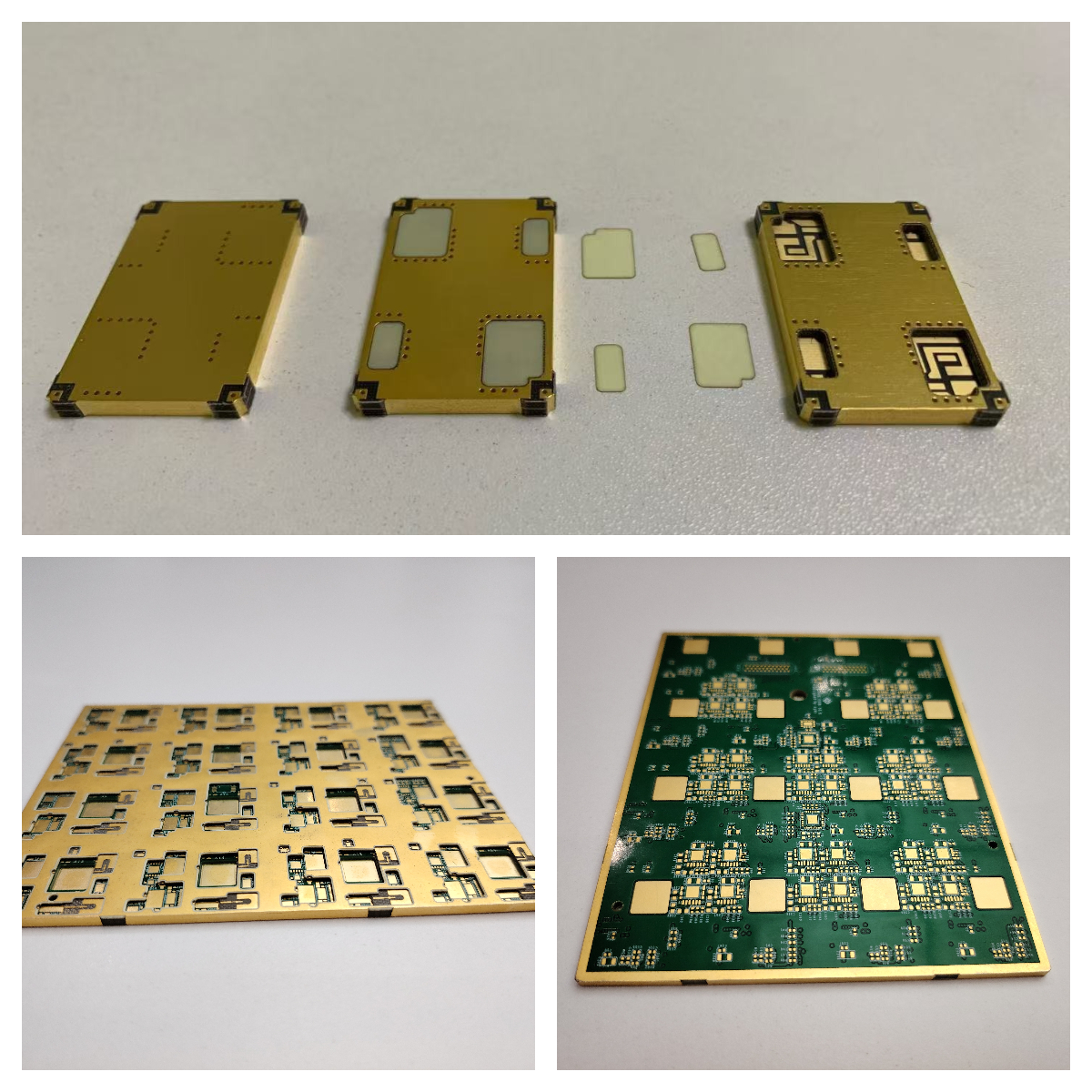
BaiNeng YunBan Embedded Copper Block PCB Product Showcase
trending news
Contact Us