



Sorry, no sales person is available right now to take your call. Pls leave a message and we will reply to you via email as soon as possible.
Home/ PCB News/ Working Principle of Piezoelectric Ceramic Sensors and Their Applications in Humanoid Robots
Working Principle of Piezoelectric Ceramic Sensors and Their Applications in Humanoid Robots
2026-03-16
Piezoelectric ceramic sensors operate based on the piezoelectric effect: when the material is subjected to mechanical stress, its internal charge distribution undergoes a regular change, generating a detectable potential difference. This unique electromechanical coupling characteristic enables direct conversion of mechanical signals into electrical signals without requiring additional signal transduction media, thereby simplifying the sensor system’s structure.
A typical piezoelectric ceramic sensor adopts a "bolt-clamped metal-ceramic sandwich structure." This design eliminates the need for transmission mechanisms used in conventional sensors and relies on the direct deformation of the piezoelectric material itself to achieve energy conversion, significantly reducing the device's size and complexity. Compared with traditional capacitive or resistive sensors, this contactless measurement approach effectively minimizes mechanical wear, lowers failure rates, and substantially enhances the reliability and service life of the entire sensing system.
Advanced piezoelectric ceramic sensors exhibit exceptional overall performance, with the following core characteristics:
Ultra-high resolution: Measurement accuracy reaches the 15-nanometer level—far surpassing conventional sensors—and can capture minute mechanical changes;
Extremely fast response: Response time is approximately 0.5 milliseconds, enabling rapid feedback of mechanical signals and fully meeting real-time control requirements;
Low hysteresis: Hysteresis rate is below 3.95%, effectively preventing signal distortion and ensuring measurement accuracy;
Wide operating temperature range: Functional across temperatures from -40°C to +125°C, suitable for complex industrial and robotic environments;
Excellent linearity: Nonlinearity is less than 0.1% of full scale (FS), guaranteeing stability and consistency of measurement data.
These outstanding performance parameters give piezoelectric ceramic sensors a significant technological edge over traditional sensors in high-precision, fast-response, and complex-environment sensing applications, laying a solid foundation for their use in humanoid robotics.
I. New Possibilities in Humanoid Robot Joints
In humanoid robot joints, piezoelectric ceramic sensors are primarily applied in two core roles—as actuators and as sensing elements—each serving distinct joint operational needs.
When used as actuators, piezoelectric ceramic sensors achieve micro-displacement amplification through a friction-coupling mechanism: an applied electrical signal induces micrometer-scale deformation in the piezoelectric ceramic element, which is then amplified via specially designed mechanical structures into millimeter- or even centimeter-scale macroscopic motion to drive precise joint actions. However, this application faces three major challenges:
Precise friction control: The friction coefficient at the contact interface must be tightly regulated, as temperature fluctuations and mechanical wear directly impact the stability and precision of displacement output;
High-precision assembly requirements: Preload pressure on the piezoelectric ceramic element must be controlled within ±5%; excessive or insufficient preload significantly affects actuation efficiency and component lifespan;
Complex control algorithms: Specialized compensation is required for inherent nonlinearities and hysteresis in the piezoelectric effect, making controller development challenging and demanding high algorithmic precision.
Compared to direct use as actuators, piezoelectric ceramic sensors are better suited as torque sensors integrated into robot joints, offering three key advantages:
Three-dimensional force detection capability: Simultaneously and accurately measures force components along the x, y, and z axes, comprehensively capturing mechanical changes during joint motion and providing complete data support for joint control;
Superior dynamic response: Response speed is 5–10 times faster than traditional strain-gauge sensors, enabling rapid feedback of torque changes and meeting the demands of high-speed joint motion and real-time control;
Strong electromagnetic interference (EMI) immunity: Maintains stable measurement performance even in electromagnetically complex environments with densely packed motors in robot joints, avoiding signal distortion caused by EMI.
II. Fingertip Tactility: Enabling Robots to “Handle Gently and Perceive Accurately”
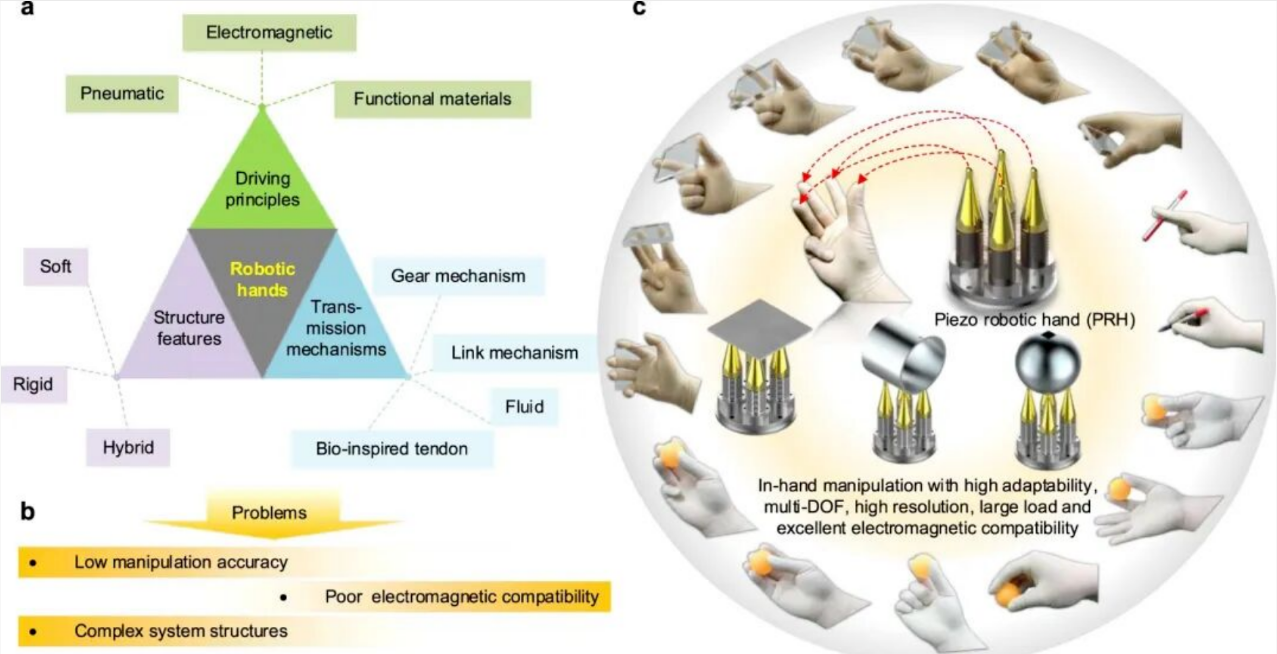
In contact areas such as fingers and palms of humanoid robots, piezoelectric ceramic sensors can form high-sensitivity tactile arrays that emulate human fingertip perception, enabling robots to achieve “precise sensing and compliant manipulation.” This application manifests in three dimensions:
Pressure distribution mapping: By arranging piezoelectric ceramic sensors in an array, the spatial pressure distribution between the robot hand and an object can be captured in real time, clearly revealing contact status and preventing localized excessive pressure that could damage objects;
Dynamic tactile feedback: Rapidly identifies fine surface features such as texture, hardness, and roughness, endowing robots with “tactile discrimination” capabilities to adapt to grasping objects of varying materials and shapes;
Precise grip force control: Dynamically adjusts gripping force based on real-time tactile feedback, enabling compliant grasping—securely holding heavy objects while gently handling fragile or delicate items—greatly enhancing operational flexibility and safety.
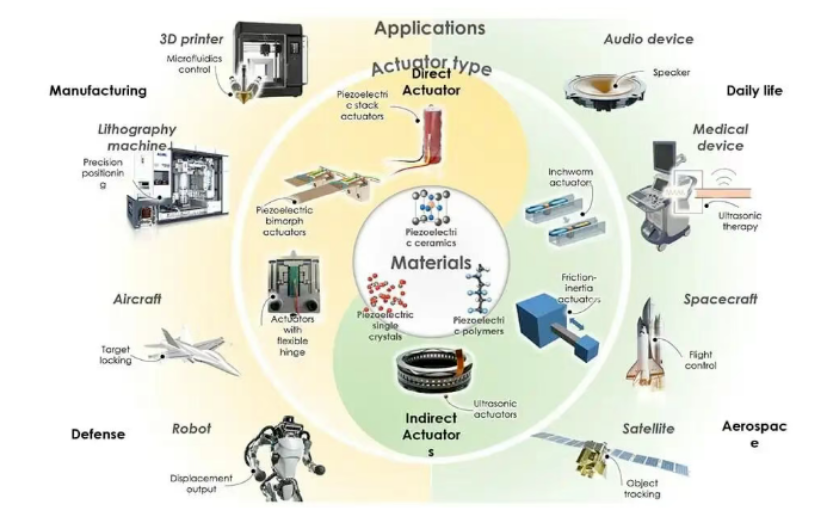
In summary, piezoelectric ceramic sensors offer significant technical advantages in critical humanoid robot applications—including dynamic force measurement, tactile perception, and vibration monitoring—thanks to their high sensitivity, rapid response, low power consumption, and strong EMI immunity. From an engineering perspective, at the current stage, they are best deployed as complementary upgrades to existing sensing systems, working in synergy with conventional technologies rather than fully replacing them. With future breakthroughs in optimization, their application scope will further expand, providing stronger support for the intelligent evolution of humanoid robots.
trending news
Contact Us