



Sorry, no sales person is available right now to take your call. Pls leave a message and we will reply to you via email as soon as possible.
Home/ PCB News/ AI Servers Reshaping the PCB Industry Chain: From Material Upgrades to Equipment Bottlenecks, Who’s Capturing the Next Frontier?
AI Servers Reshaping the PCB Industry Chain: From Material Upgrades to Equipment Bottlenecks, Who’s Capturing the Next Frontier?
2026-07-23
In 2026, the PCB industry is undergoing an unprecedented wave of capacity expansion. Unlike previous cycles driven by gradual penetration of end products, this round is fueled by the explosive demand created by AI computing power. Global AI server shipments are expected to surpass 2 million units in 2026, a 55% year-over-year increase, directly driving high-end PCB demand growth of over 110%. The value of PCBs used in a single AI server is nearly 10 times that of a standard server.
Citi Securities forecasts that the global PCB market size for AI applications will reach RMB 152 billion, RMB 307 billion, and RMB 562 billion in 2026, 2027, and 2028, respectively. AI is reshaping the growth logic of the PCB industry.
Beneath this boom, a multi-layered supply-demand tug-of-war is unfolding across the PCB supply chain—from capacity expansion to materials and equipment.
This article was compiled by BaiNeng YunBan based on market conditions and is for reference only.
I. Capacity Expansion: Capital Expenditure Surges, Led by Industry Leaders
In 2025, capital expenditures by nine leading PCB companies reached RMB 26.7 billion, up 111% year-over-year; in Q1 2026 alone, capex hit RMB 12.5 billion, with year-over-year growth accelerating further to 182%.
The momentum has only intensified in 2026. According to Cailian Press Xingkuang data, as of June 9, at least 20 A-share listed PCB companies have announced capacity expansion plans, with total investments exceeding RMB 80 billion. Brokerage estimates further indicate that Chinese PCB manufacturers have disclosed cumulative expansion investments of RMB 71.2 billion since the beginning of 2026.
Leading players are particularly active. Shenghong Technology unveiled a RMB 20 billion annual investment plan, fully focused on high-layer-count PCBs for AI servers and optical module production lines. Wus Printed Circuit (Kunshan) has been expanding capacity at a pace approaching “one investment per month,” with total investments reaching RMB 17.6 billion this year. PPT Vision invested RMB 11 billion in Huai’an to build a high-end PCB production base, bringing its full-year capex to RMB 16.8 billion. Additionally, Wellgo Electronics announced in July a proposed private placement to raise up to RMB 1.3 billion for high-end AI-related PCBs and a smart manufacturing project in Thailand.
Currently, capacity expansion is led by Shenghong Technology, Wus Printed Circuit, and PPT Vision, with Shen Nan Circuit, Kinwong Electronic, Founder Tech, and Guanghe Technology expected to accelerate efforts in the next phase.
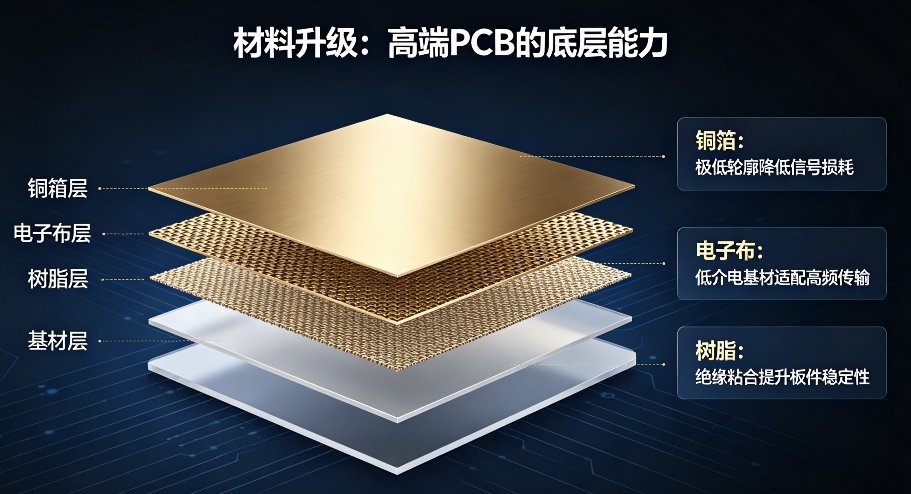
II. Materials: Copper Foil, Electronic Fabric, and Resin—the "Three Pillars" of PCBs
A PCB is not just a simple “board.” Its physical foundation consists of three key materials: copper foil, electronic fabric (glass fiber cloth), and resin.
Copper foil serves as the conductive “highway network” of the PCB; its thickness uniformity, conductivity, and surface quality directly affect impedance control and signal integrity. Electronic fabric, woven from ultra-fine glass fibers, acts like “rebar,” providing mechanical strength and dimensional stability. Its dielectric constant (Dk) and dissipation factor (Df) critically influence high-speed signal transmission speed and energy loss. Resin functions like “cement,” bonding the fabric and copper foil while offering insulation protection.
When upgrading to high-end PCBs, it’s not just about board makers expanding capacity—specifications for all three materials also improve simultaneously, making supply shortages more likely to concentrate upstream.
(1) Copper Foil: Smoother Equals More Valuable
As AI chip computing density increases, single-lane signal transmission rates have surpassed 224 Gbps, with Nyquist frequencies reaching 56 GHz. At this frequency, the skin depth of high-frequency signals is only 0.27 μm—meaning current flows almost entirely within an extremely thin surface layer of the copper foil. Standard copper foil has a surface roughness of approximately 6–8 μm, far exceeding the skin depth, causing significant conductor loss and signal reflection.
The solution is HVLP (Hyper Very Low Profile) copper foil. Through specialized surface treatment processes, HVLP foil has progressively reduced roughness from Rz ≤ 2.0 μm in first-generation products to Rz ≤ 0.5 μm in fifth-generation versions. The smoother the surface (higher generation), the lower the signal loss.
However, supply of high-end HVLP foil is falling far short of demand. Industry sources estimate a 1,500-ton shortfall for HVLP4 foil in 2026, widening to 2,500 tons in 2027. Third-party analysis shows that monthly demand for fourth-generation HVLP foil for AI servers surged from 590 tons to 1,300 tons in Q2 2026, while available supply was just over 600 tons—creating a monthly gap of 666 tons, or a shortage rate exceeding 50%. Goldman Sachs projects that, considering major suppliers’ HVLP3+ product yields remain at only 70–80%, effective supply gaps will reach 28%, 39%, and 38% in 2026, 2027, and 2028, respectively.
This imbalance is directly reflected in pricing. Processing fees for HVLP4 copper foil have soared to RMB 200,000 per ton—nearly 10 times higher than the RMB 18,000–22,000 per ton for standard foil. The trend of rising processing fees is clear, and the supply-demand imbalance is unlikely to reverse in the short term.
(2) Electronic Fabric: Three Generations of Upgrades from E-Glass to Q-Glass
Electronic fabric is also undergoing structural upgrades. First-generation E-Glass is mature; second-generation Low-Dk modified specialty glass fabric, with enhanced dielectric properties through adjusted glass formulations, has become the dominant substrate in AI computing servers; third-generation Q-Glass aims to address ultra-high-frequency signal loss.
Meanwhile, as PCB layer counts increase while overall thickness must be controlled, electronic fabric is shifting from 1080/1087 specifications to 1067 and even finer grades. Fiber opening and flattening processes—using mechanical or high-pressure water jets to spread fiber bundles and eliminate voids—ensure high-speed signals on differential pairs transmit without timing distortion.
Prices for electronic fabric have also risen sharply. Honghe Technology’s average selling price per meter jumped from RMB 4.50 in Q1 2025 to RMB 9.78 in Q1 2026—a 117% year-over-year increase. Since 2026, prices have undergone five rounds of adjustments, with mainstream 7628-grade fabric averaging RMB 7.40 per meter, doubling from its Q3 2025 low. In Q2, the average price rose further to RMB 6.70 per meter (up 28.8% quarter-over-quarter), and by July had surged to RMB 8.60 per meter, surpassing the 2021 cycle peak.
(3) Copper Clad Laminates (CCL): Ten Rounds of Price Hikes Transmit Upstream Pressure
As the core substrate of PCBs, CCL absorbs pricing pressures from copper foil, electronic fabric, and resin. Since 2025, industry leader KB Group’s main products have undergone ten rounds of price increases, with some variants rising by as much as 20% per adjustment. In 2026, the pace has accelerated—by July, KB had issued six price hike notices, with only 20 days between the latest two. Industry data shows KB’s CCL products have cumulatively increased by over 50% in 2026, setting a new three-year record for pricing frequency.
This pricing surge is directly boosting sector earnings. CCL leader Shengyi Technology forecasts H1 2026 net profit attributable to shareholders at RMB 3.099–3.298 billion, up 117–131% year-over-year.
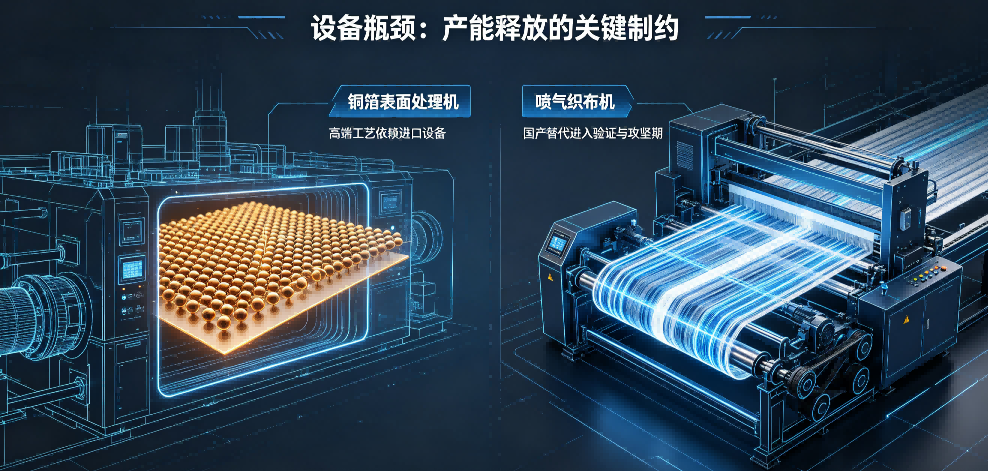
III. Equipment: Surface Treatment Machines and Air-Jet Looms—the Two "Bottleneck" Links
Material capacity expansion ultimately depends on equipment. In the production chains for copper foil and electronic fabric, two critical equipment segments have become key bottlenecks limiting capacity release.
(1) Copper Foil Equipment: Surface Treatment Machines Are the Real Bottleneck
Copper foil production involves three stages: copper dissolution, foil formation, and post-treatment (surface treatment). Cathode rollers and foil-making machines already enjoy high domestic localization rates—as of 2024, Taijin New Energy held 45% of the cathode roller market, while Hongtian Corporation commanded a significant share; in foil-making machines, Hongtian’s market share reached 48%.
However, the key incremental equipment for HVLP foil expansion is the surface treatment machine. The challenge lies in uniformly growing micro-copper particles of just 50–200 nm on an ultra-smooth copper surface—enhancing resin adhesion without increasing roughness. Surface treatment machines for HVLP1–3 are largely localized, but HVLP4–5 generations still rely primarily on imported suppliers like Japan’s Mitsubune, Nurlon, and PNT. Core equipment such as Nippon Steel and Mitsubune’s surface treatment machines are currently in short supply.
Domestic equipment makers are now prioritizing HVLP4–5 surface treatment machine localization. Hongtian has industrialized a full series from 3.5 μm to 100 μm and is actively advancing HVLP4/5 surface treatment machine substitution.
(2) Electronic Fabric Equipment: Air-Jet Looms Depend on Imports
Electronic fabric production equipment includes bushing furnace fiber drawing lines, twisting machines, and looms. The most critical is the air-jet loom—which uses compressed air to propel weft yarn through the shed, enabling high-speed, high-precision weaving.
Yet over 90% of global high-end electronic fabric capacity relies on Toyota’s JAT910-series looms, resulting in extreme import dependence. Toyota and Tsudakoma’s electronic fabric looms are also in short supply. Analysts note that orders for imported equipment are booked out beyond 2028.
On the localization front, Titan Textile Machinery’s TQ600 loom is being validated in thin fabric markets and also has presence in twisting machines; Saurer’s VGT-9 series has already substituted Toyota twisting machines. However, validation and scale-up of ultra-thin looms will take time.
IV. Full Supply Chain View: The Transmission Chain from Capacity to Materials to Equipment
The logic across the entire chain is clear:
Capacity Expansion: Led by Shenghong Technology, Wus Printed Circuit, and PPT Vision, with Shen Nan Circuit, Kinwong Electronic, Founder Tech, etc., following closely.
Copper Foil Materials: Tongguan Copper Foil has HVLP1–4 capabilities, with Gen 5 achieving key performance breakthroughs; Defu Technology has mass-produced HVLP1–2 and achieved China’s first HVLP3 mass-production substitution; Hailiang Group is making progress in RTF and HVLP high-end standard foils.
Electronic Fabric Materials: China Jushi is advancing low-Dk fiberglass and electronic fabric R&D; Honghe Technology maintains long-term partnerships with CCL makers like TUC, ITEQ, Shengyi, and Panasonic; Feilihua offers ultra-thin, super-thin, and ultra-fine yarn fabrics; Sinoma Science & Technology has self-developed fiber drawing equipment.
Key Equipment: Taijin New Energy supplies cathode rollers, titanium anodes, foil-making machines, and surface treatment machines; Hongtian’s electrolytic copper foil equipment accounts for most revenue, with 48% China market share in foil-making machines in 2024; Titan and Saurer are advancing localization in looms and twisting machines, respectively.
Conclusion
AI server demand for PCBs represents not just quantitative growth, but a qualitative leap. From the ultra-low roughness requirements of HVLP copper foil and the dielectric performance upgrades of Low-Dk electronic fabric to the equipment bottlenecks in surface treatment machines and air-jet looms—every link tests the technological depth of China’s PCB supply chain.
Leading PCB manufacturers already have orders locked in through 2027. As new capacity ramps up in H2 2026 through 2027, high-end PCB supply capability is expected to fully materialize by 2028. In this AI-driven industrial wave, whoever breaks through the “bottleneck” links in materials and equipment first will likely capture the next strategic advantage.
trending news
Contact Us