


Sorry, no sales person is available right now to take your call. Pls leave a message and we will reply to you via email as soon as possible.
Home/ PCB News/ Power Consumption Surpasses 2850W! DPC Ceramic Substrates Forge the Next-Generation AI Server Heat Dissipation Base
Power Consumption Surpasses 2850W! DPC Ceramic Substrates Forge the Next-Generation AI Server Heat Dissipation Base
2026-06-16
With the rapid iteration of generative artificial intelligence and large model technologies, global AI computing power demand is experiencing explosive growth. While AI chip performance continues to improve, power consumption thresholds are constantly being pushed higher, making ultra-high power consumption a core technical challenge for thermal management and packaging in high-end AI servers. Represented by NVIDIA's next-generation Rubin (R200) AI chip, single-chip power consumption has already surpassed 2850W, far exceeding the 2000W thermal dissipation limit of traditional HDI printed circuit boards. Conventional organic substrates centered on FR-4, due to inherent shortcomings such as insufficient thermal conductivity and poor structural stability, can no longer meet the packaging and thermal management requirements of ultra-high-power AI chips, becoming a critical bottleneck constraining the iteration of high-end computing hardware. Against this backdrop, DPC (Direct Plated Copper) ceramic substrates—featuring ultra-high thermal conductivity, excellent mechanical stability, and high-precision wiring capabilities—are emerging as the core thermal solution for addressing the 2850W-class ultra-high-power AI chip cooling challenge and enabling scalable deployment of 2.5D advanced packaging, thereby supporting stable and efficient operation of high-end AI servers. The industry is now entering a period of dual dividends from technological iteration and market expansion.
I. Bottlenecks of Traditional Organic Substrates Become Evident; New Thermal Architectures Accelerate Iteration
High-end AI chips are progressively evolving toward larger sizes, higher densities, and greater power levels, making the material limitations and process bottlenecks of traditional organic substrates increasingly pronounced. These have become major constraints on upgrading high-performance computing hardware. Thermally, FR-4 organic substrates exhibit extremely low thermal conductivity, making it difficult to rapidly dissipate concentrated heat flux generated by chips. Prolonged high-temperature operation can lead to device throttling, reduced stability, and shortened lifespan, failing to meet the thermal management demands of sustained high-compute workloads. Structurally, organic substrates suffer from insufficient rigidity and high coefficients of thermal expansion, causing warpage and deformation during large-area packaging and multi-step assembly processes. This significantly reduces chip packaging yield and assembly precision, hindering mass production scalability. In terms of manufacturing, traditional substrates have limited fine-feature processing capabilities, with inadequate via size and pitch accuracy, making them incompatible with the miniaturization and high-density wiring requirements of advanced chips and unable to meet 2.5D advanced packaging standards—thus completely losing their ability to support mass production and stable operation of 2850W ultra-high-power AI servers.
To address these industry pain points, the hybrid integration architecture combining "HDI PCB + DPC ceramic substrate" has been widely adopted as the mainstream thermal solution for high-power AI servers. This approach avoids the high cost of full-board material replacement by embedding DPC ceramic substrates only in core regions with high heat flux density and high current loads—accounting for approximately 30% of the total board area. This architecture retains the cost-effective, large-area wiring advantages of traditional HDI PCBs while leveraging ceramic materials for localized high-efficiency heat dissipation, balancing performance and manufacturing economics. Currently, this solution has been validated and commercially deployed at scale by leading global server manufacturers, representing the optimal thermal management strategy for 2850W ultra-high-power computing chips.
II. Core Technical Advantages of DPC Ceramic Substrates Fully Align with High-End AI Packaging Requirements
As a new generation of high-performance electronic packaging substrate, DPC ceramic substrates effectively overcome multiple technical shortcomings of traditional organic substrates. With superior thermal performance, stable mechanical structure, and flexible process adaptability, DPC ceramic substrates comprehensively meet the packaging demands of high-end AI chips under ultra-high-power operating conditions, precisely resolving the three core challenges of heat dissipation, warpage, and high-density wiring posed by 2850W-class computing chips. They have become the foundational thermal platform enabling stable operation of next-generation AI servers.
In terms of thermal performance, DPC ceramic substrates achieve a thermal conductivity of up to 200 W/(m·K)—more than two orders of magnitude higher than conventional FR-4 materials—offering exceptional heat dissipation advantages. Their coefficient of thermal expansion closely matches that of silicon chips, effectively preventing thermal mismatch, interfacial cracking, and coating delamination under high-temperature conditions. When integrated into HDI hybrid structures, the overall package thermal resistance can be reduced by over 70%, establishing a vertically efficient heat conduction pathway to rapidly channel concentrated chip heat flux and fundamentally overcoming the thermal bottleneck of 2850W ultra-high-power AI chips, ensuring sustained and stable operation of high-end AI servers.
Regarding mechanical structure, DPC ceramic substrates exhibit high rigidity, minimal deformation, and excellent flexural strength, enabling warpage control within extremely tight tolerances throughout the entire manufacturing process—including component placement, reflow soldering, and packaging tests—significantly improving packaging yield and system reliability. Additionally, these products support ultra-thin custom designs, effectively reducing overall package thickness and facilitating lightweight, miniaturized upgrades for AI servers and computing terminals, providing robust structural support for the mass commercialization of 2850W ultra-high-power AI chips.
In process development, DPC ceramic substrates feature pre-sintering formability, allowing precise micro-via fabrication during green-body shaping to achieve smaller via diameters and narrower pitches for high-density circuit routing—surpassing the wiring limitations of traditional substrates. Leveraging 3D立体 wiring architectures enables highly integrated circuits that fully satisfy the high-density interconnect requirements of advanced xPU and ASIC chips as well as 2.5D advanced packaging. Moreover, front-end simulation-driven development allows multidimensional data output—including thermal, electrical, and structural deformation metrics—during the design phase, helping enterprises optimize solutions, shorten R&D cycles, reduce trial-and-error costs, and rapidly iterate to meet packaging demands for 2850W+ ultra-high-power AI servers.
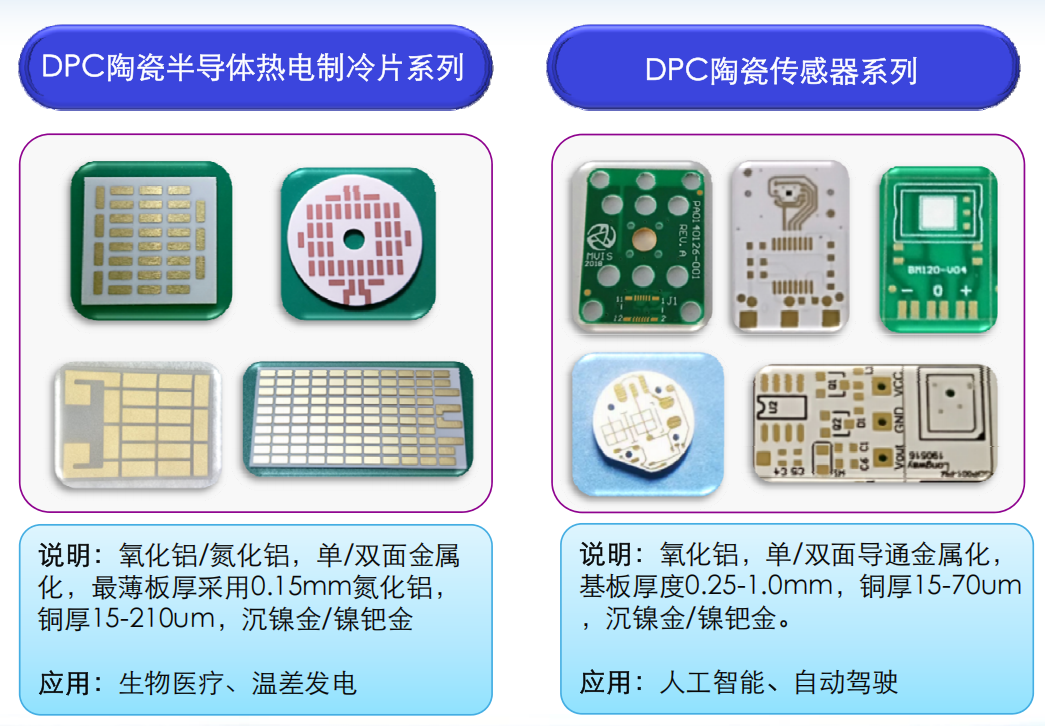
Baineng Yunban DPC Process Product Showcase
III. Global Oligopolistic Market Structure Solidifies; Domestic Technological Breakthroughs Enable Import Substitution
The global high-end DPC ceramic substrate industry features triple high barriers—technology, process, and customer certification—resulting in high market concentration and a long-standing oligopolistic structure. Overseas leaders such as Japan’s Kyocera and Maruwa, along with Taiwan’s TTM Technologies, possess deep technological foundations, with the top five global players collectively holding a 70% market share. Leveraging mature mass-production processes, consistent product quality, and comprehensive certification systems, these overseas firms have long dominated high-value markets including high-end computing, optical communications, and laser equipment—particularly establishing a solid monopoly in ultra-high-power (2850W) AI server thermal substrates.
With the rise of China’s high-end electronic materials industry, domestic breakthroughs have been achieved in core DPC technologies—including metallization processes, precision micro-via machining, and hybrid integrated packaging. Leading Chinese manufacturers like Baineng Yunban have now mastered scalable mass-production capabilities for high-end products, breaking long-standing overseas technological blockades and market monopolies. Domestic DPC substrates offer advantages such as cost control, supply chain autonomy, rapid local service response, and strong customization capabilities, enabling swift adaptation to China’s 2850W-class ultra-high-power AI server mass-production needs. The import substitution potential is vast, and the pace of domestic replacement continues to accelerate.
IV. Downstream Computing Demand Explodes; Industry Market Size Enters Rapid Expansion Phase
DPC ceramic substrates have mature applications in traditional sectors such as high-power lighting, industrial lasers, high-end optical communications, and thermoelectric cooling, with a well-established downstream ecosystem and stable industry fundamentals. According to HNY Research, the global DPC ceramic substrate market was valued at approximately $2.1 billion in 2021 and is projected to reach $2.82 billion by 2027, growing at a CAGR of 5.07% from 2021 to 2027, reflecting steady growth in traditional segments.
The proliferation of generative AI and large-scale global data center construction are injecting entirely new growth momentum, shifting the industry from steady growth to explosive expansion. Rising AI chip power consumption and rapidly increasing adoption of 2.5D advanced packaging are driving surging demand for specialized DPC substrates for 2850W-class AI servers, opening a new high-growth trajectory. Segment-specific data shows the global AI server ceramic substrate market is growing rapidly, with projections exceeding RMB 5 billion by 2026 and surpassing RMB 12 billion by 2028—a CAGR exceeding 60% from 2026 to 2028—making it the most certain and high-growth segment among high-end electronic materials tailored for ultra-high-power AI computing hardware.
V. Industry Development Outlook
Current AI computing hardware continues to evolve toward higher power, greater density, miniaturization, and enhanced reliability. The widespread adoption of advanced HDI and 2.5D/3D packaging technologies further amplifies the material and process advantages of DPC ceramic substrates. With exceptional thermal performance, stable mechanical structure, and high-precision wiring capabilities, DPC substrates are uniquely aligned with the iterative needs of high-end computing hardware and represent the only scalable foundational substrate currently capable of supporting stable operation of 2850W ultra-high-power AI servers.
Looking ahead, driven by continuous domestic technological breakthroughs, explosive growth in AI computing demand, and accelerated supply chain localization, DPC ceramic substrates will progressively replace traditional organic substrates, achieving large-scale penetration in AI data centers, high-end computing servers, and high-performance computing devices. The industry offers ample long-term growth potential and will continue capturing the iteration红利 from 2850W+ ultra-high-power AI chips, serving as the core thermal foundation supporting high-quality development of China’s AI hardware and advanced packaging industries and enabling autonomous, controllable, and efficiency-enhanced computing supply chains.
VI. Future Industry Trends by Segment
Material Upgrades Toward Premium Grades
Current mainstream alumina-based DPC substrates face performance ceilings in thermal and mechanical properties, making them unsuitable for 3000W+ ultra-high-power AI chips. The industry will accelerate its shift toward high-thermal-conductivity ceramic materials such as aluminum nitride and silicon nitride, leveraging their superior thermal conductivity and stability to meet extreme operating conditions in high-end computing. Simultaneously, the industry will continuously optimize sintering and raw material purification processes to reduce mass-production costs of premium substrates, establishing a tiered product portfolio to sustainably meet long-term upgrade demands for 2850W+ ultra-high-power AI servers.
Process Evolution Toward Precision Integration
As 2.5D/3D advanced packaging penetration increases, DPC substrate processes are advancing toward greater precision, ultra-thinness, and integration. Micro-via machining and circuit etching precision continue to improve, meeting high-density interconnect demands of advanced chips; ultra-thin substrate mass-production techniques are maturing, enabling lightweight and miniaturized computing devices. Meanwhile, the "DPC + PCB hybrid integration" architecture is becoming standardized and scalable, emerging as the dominant implementation solution for 2850W+ ultra-high-power AI server packaging.
Application Focus Shifts to Computing Power Segments
Traditional DPC substrate applications have centered on lighting, optical communications, and laser equipment, exhibiting steady growth. Future industry growth will pivot decisively toward high-end AI computing, deeply penetrating core scenarios such as AI servers, GPU computing modules, and high-performance computing chips—with a sharp focus on the thermal management needs of 2850W ultra-high-power AI servers. Additionally, leveraging material advantages, the industry will expand into high-end domains like automotive power semiconductors and millimeter-wave communications, forming a new application landscape centered on ultra-high-power AI server cooling and supported by multiple high-end segments.
Industry Structure Accelerates Domestic Consolidation
The global DPC industry’s oligopolistic structure is gradually loosening, with import substitution entering deep implementation. Domestic leaders, leveraging autonomous supply chains, cost control, and efficient local service, are steadily capturing high-end overseas market share. Competitive dynamics have fundamentally shifted—from low-end price competition to comprehensive rivalry based on advanced processes, mass-production yields, customer certifications, and customization capabilities. Low-end, inefficient capacity is continuously exiting the market, with resources accelerating toward high-quality domestic leaders, further solidifying the industrial foundation for domestically produced 2850W ultra-high-power AI thermal substrates.
VII. Core Industry Development Risks
High-End Technology and Process Barrier Risk
High-end AI-grade DPC substrates sit at the intersection of materials science, precision manufacturing, and semiconductor packaging, presenting extremely high technical barriers. Overseas leaders, with decades of experience, hold extensive patent portfolios and mature processes, demonstrating clear advantages in product stability and consistency under ultra-high-power conditions. Although domestic firms have achieved technological breakthroughs, gaps remain in ultra-high-precision mass production and long-term high-temperature stability. Dependence on imported high-end raw materials and equipment introduces uncertainty in penetrating the 3000W+ ultra-high-power AI substrate market.
Downstream Customer Certification Cycle Risk
AI computing supply chains enforce stringent certification protocols. As a core packaging substrate, DPC substrates must undergo multiple rounds of reliability testing, batch validation, and compatibility tuning, resulting in certification cycles lasting 1–3 years. Domestic products face significant difficulty and slow adoption timelines when entering leading computing vendors’ supply chains, risking high R&D investment with low capacity utilization and delaying industrialization of domestic ultra-high-power AI thermal substrates.
Structural Market Competition Risk
The industry exhibits pronounced structural segmentation: high-end AI-specific DPC products face capacity shortages and strong demand, reliably meeting 2850W thermal requirements; meanwhile, the mid-to-low-end segment has low entry barriers, attracting numerous players and leading to overcapacity and homogenized competition. Persistent price wars and margin pressure in the low-end segment squeeze overall industry profitability, hindering high-quality development toward ultra-high-power computing applications.
Technology Iteration and Demand Volatility Risk
Industry growth is highly dependent on AI computing sector prosperity. A contraction in global computing capital expenditure or slowdown in AI chip iteration could directly reduce demand for ultra-high-power thermal substrates. Additionally, rapid advancements in semiconductor packaging and thermal materials may introduce alternative technologies that potentially displace DPC substrates in ultra-high-power AI server applications.
Supply Chain and Cost Volatility Risk
Production of DPC substrates relies partially on imported high-end ceramic powders, high-purity copper, and precision manufacturing/testing equipment, making them vulnerable to international trade policies and market fluctuations. Price volatility and unstable delivery cycles for raw materials and equipment directly impact production costs and mass-production stability, posing ongoing supply chain risks to scalable delivery of ultra-high-power AI-specific DPC substrates.
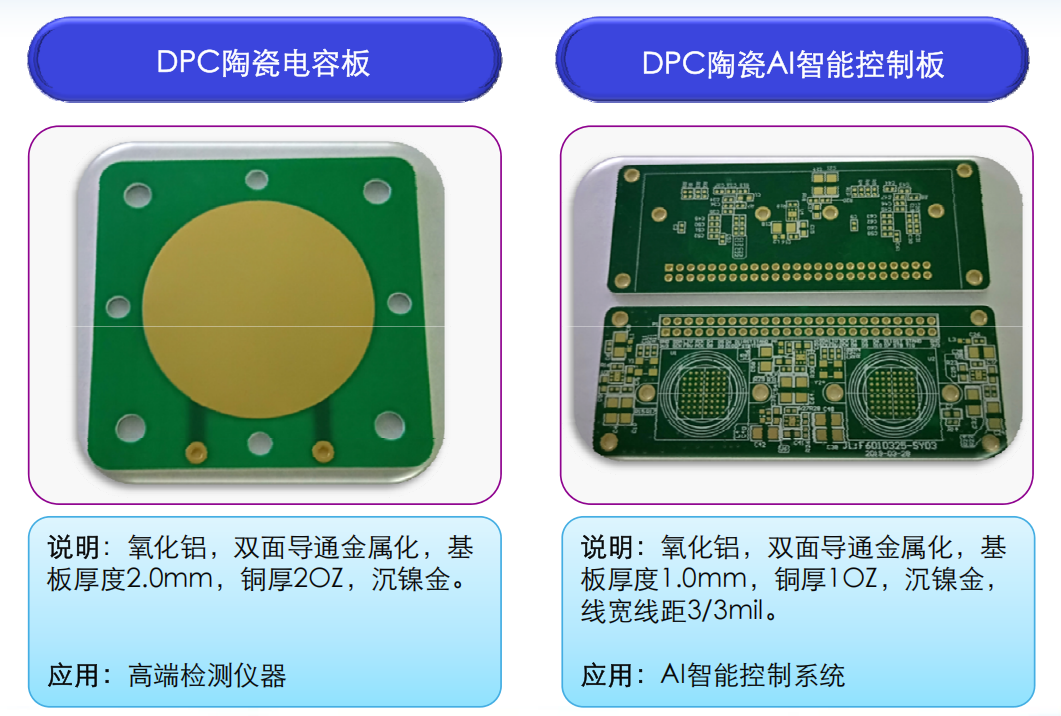
Partial Product Showcase of Baineng Yunban DPC Process Ceramic Substrates
trending news
Contact Us