


Sorry, no sales person is available right now to take your call. Pls leave a message and we will reply to you via email as soon as possible.
Home/ PCB News/ Application Analysis of High-Precision Thick-Film Screen Printing Technology in Ceramic Substrate Processing for Dielectric Ceramic Antennas
Application Analysis of High-Precision Thick-Film Screen Printing Technology in Ceramic Substrate Processing for Dielectric Ceramic Antennas
2026-01-27
As a core component for signal reception, the performance of dielectric ceramic antennas directly determines the accuracy and operational reliability of positioning systems. These antennas exhibit excellent anti-interference, lightning protection, waterproofing, and dustproof characteristics, and have been widely applied in critical fields such as automotive navigation, intelligent transportation, and smart agriculture, becoming a key enabler for signal transmission in IoT terminal devices.
1. Core Structural Components of Dielectric Ceramic Antennas
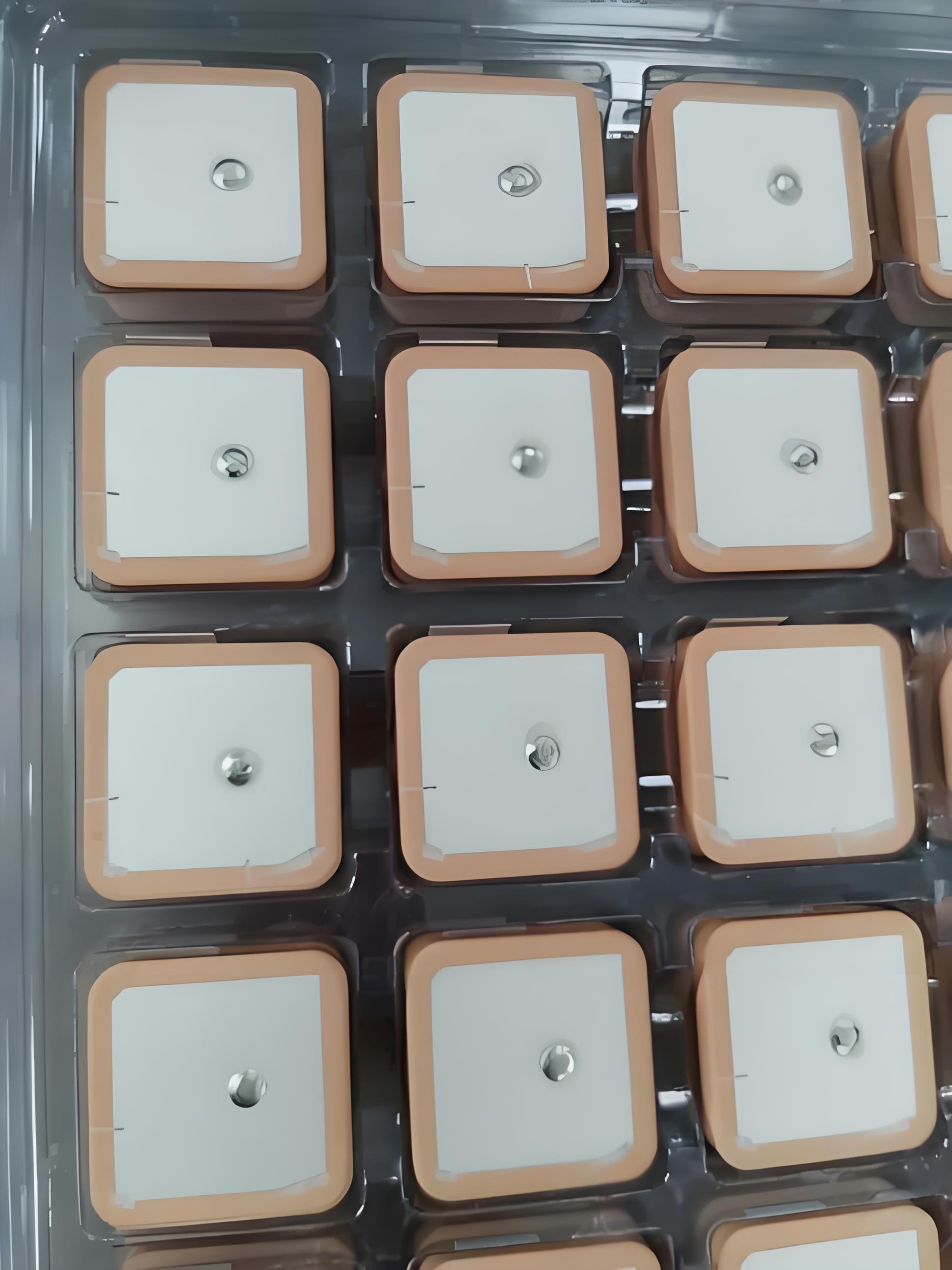
A dielectric ceramic antenna consists of four key components: the ceramic antenna element, low-noise signal module, transmission cable, and connector. Among these, the ceramic antenna element is the core unit determining signal reception performance and is primarily composed of a ceramic substrate and a silver paste layer. The specifications and parameters of each component directly impact the overall antenna performance.
Ceramic Substrate: Common standard dimensions include 38×38mm, 25×25mm, 18×18mm, 15×15mm, and 12×12mm. Under identical manufacturing conditions, larger substrate areas yield higher dielectric constants, resulting in more stable antenna resonance frequencies and improved signal reception sensitivity and coverage range. Selection can be flexibly tailored based on available installation space and performance requirements of different terminal devices.
Silver Paste Layer: As the critical medium for signal transmission, its manufacturing precision directly determines antenna gain and frequency stability. Key control parameters include: pattern accuracy within ±10μm, thickness uniformity deviation no greater than ±5%, and double-sided registration error ≤15μm. Precise control of these three indicators is essential to ensure efficient signal transmission.
2. Core Application Scenarios and Control Points of Thick-Film Screen Printing Technology
In mass production of dielectric ceramic antennas, high-precision thick-film screen printing technology is primarily responsible for accurately forming silver paste layers on both sides of ceramic substrates. Through refined control of process parameters, this technology achieves high-precision and highly consistent silver paste layers, laying the foundation for stable antenna performance.
1. Precise Control of Printing Accuracy
The precision of the silver paste pattern directly affects antenna impedance matching and signal transmission efficiency. By optimizing core parameters such as printing pressure, squeegee angle (typically controlled between 15°–30°), and squeegee speed (adjustable from 30–80mm/s), combined with high-precision screens, precise centered printing of the silver paste layer on ceramic substrates is achieved. This ensures sharp pattern edges without burrs, ink bleeding, or blurring, maintaining printing accuracy within ±10μm to meet stringent requirements for high-frequency signal transmission.
2. Precise Control of Silver Paste Layer Thickness
Silver paste layer thickness is a critical factor influencing antenna resonance frequency. Excessive thickness can cause frequency drift and increased signal attenuation, while insufficient thickness reduces signal transmission efficiency and antenna lifespan. High-precision thick-film screen printing technology enables precise thickness control through closed-loop management of printing cycles, off-contact distance (typically 0.1–0.3mm), and printing pressure, complemented by real-time monitoring via in-line thickness measurement equipment. This ensures film thickness deviation remains within ±5%, guaranteeing frequency stability and signal transmission performance.
3. Efficient Achievement of Batch Printing Consistency
In mass production, batch printing consistency directly impacts product yield and manufacturing costs. High-precision thick-film screen printing technology ensures consistency through two core technologies: First, a CCD automatic alignment system enables fully automated, precise matching between substrates and screens, achieving alignment accuracy of ±5μm to ensure consistent printing precision and double-sided registration across batches. Second, a floating-head printing system dynamically compensates for pressure fluctuations during printing, maintaining constant printing pressure to achieve consistent film thickness across different batches and substrates, significantly enhancing production stability and efficiency.
3. Core Competitive Advantages of Thick-Film Screen Printing Technology
1. Broad Compatibility Meeting Diverse Requirements
This technology offers exceptional process adaptability, supporting the full range of standard ceramic substrate sizes from 38×38mm down to 12×12mm. It can also flexibly adjust printing parameters and screen designs according to customized customer requirements, satisfying diverse application scenarios—such as miniaturized automotive terminals and portable agricultural monitoring devices—and covering mainstream market needs.
2. High Automation Level Enhancing Production Efficiency
High-precision thick-film screen printing enables fully automated operations—from substrate loading, automatic alignment, printing, and drying to unloading. Compared to traditional manual or semi-automated processes, printing speed increases by 3–5 times, while human-induced errors are drastically reduced. Product yield can exceed 98%, significantly lowering production costs while ensuring quality and strengthening competitiveness in mass production.
3. Technology Implementation: Core Application Cases from BAI NENG YUN BOARD
Leveraging its core expertise in high-precision thick-film screen printing and offering customized 1–6 layer ceramic PCB services, BAI NENG YUN BOARD has developed multiple mature technical integration cases in key sectors such as automotive electronics and communication antennas, achieving precise alignment between process capabilities and market demands, as detailed below:
Automotive Navigation Antenna Ceramic Substrate Integration Case: Addressing stringent requirements for signal stability and anti-interference performance in a leading automaker’s in-vehicle navigation system, BAI NENG YUN BOARD used an Al₂O₃ ceramic substrate (25×25mm) and optimized thick-film screen printing parameters to achieve silver paste pattern accuracy within ±8μm, thickness uniformity deviation ≤3%, and double-sided registration error ≤12μm. Integrated with a low-noise signal module, the final antenna achieved a center frequency stably maintained at 1575.42MHz±3MHz (standard GPS band for vehicles), VSWR ≤2.0, and gain coverage > -4dBic. This design effectively resists electromagnetic interference from onboard electronics and harsh driving conditions, improving positioning accuracy by 15%. The solution is now in mass production supply.
Smart Transportation RFID Antenna Ceramic Substrate Customization Case: For a smart transportation solutions provider, BAI NENG YUN BOARD customized a dielectric ceramic antenna substrate for RFID reader/writer equipment, addressing demands for miniaturization and wide bandwidth. An 18×18mm silicon nitride (Si₃N₄) ceramic substrate (thermal conductivity >90W/m·K, suitable for high-temperature outdoor environments) was selected. Using thick-film screen printing, precise dual-feed points were formed on the silver paste layer. Combined with a 3dB hybrid coupler design, antenna bandwidth was effectively extended to ±5MHz, and isolation improved to over 25dB, resolving issues of signal attenuation and low recognition accuracy in high-speed scenarios. The product has been deployed in highway ETC toll systems and urban smart parking management projects.
Automotive Igniter Ceramic Antenna Integration Case: To meet high-frequency signal transmission needs in automotive igniters, BAI NENG YUN BOARD provided a customized 6-layer ceramic PCB integrated solution. High-precision thick-film screen printing was used to print silver circuit patterns on all layers, controlling interlayer registration error to ≤10μm. Additionally, packaging compatibility between the ceramic substrate and metal connectors was optimized to achieve high integration between the antenna and igniter module. The final product operates reliably from -40℃ to 125℃ and withstands lightning surges ≥8kV, meeting the demanding conditions of engine compartments. Compared to conventional discrete solutions, it reduces volume by 30% and lowers signal transmission delay by 20%.
4. Summary and Outlook
As a core enabling technology in dielectric ceramic antenna manufacturing, high-precision thick-film screen printing significantly enhances signal reception performance, frequency stability, and service life through comprehensive, precise control of printing accuracy, silver layer thickness, and registration precision. Its broad compatibility and highly efficient automated production capabilities provide essential technical support for high-quality, large-scale industry manufacturing. BAI NENG YUN BOARD’s series of implementation cases further demonstrate that deep integration of this process with ceramic PCB customization effectively addresses personalized demands in automotive electronics and intelligent transportation, translating technological advantages into product competitiveness.
As automotive electronics and smart IoT applications continue to demand higher positioning accuracy and signal stability, dielectric ceramic antennas will evolve toward miniaturization, higher frequencies, and greater integration. High-precision thick-film screen printing technology will also undergo further optimization, integrating deeply with AI-powered visual inspection and digital twin technologies to enable adaptive process parameter tuning and full-lifecycle quality control. Going forward, BAI NENG YUN BOARD will continue to advance co-innovation in ceramic PCB customization and thick-film printing processes, focusing on high-frequency, high-reliability application scenarios to deliver more market-aligned technical solutions and play an increasingly vital role in technological leadership and industrial support within the dielectric ceramic antenna manufacturing sector.
trending news
Contact Us