


Sorry, no sales person is available right now to take your call. Pls leave a message and we will reply to you via email as soon as possible.
Home/ PCB News/ Metal Core PCB | High-Efficiency Heat Dissipation, High Reliability, and Miniaturization Empower Advanced Electronics Across Multiple Industries
Metal Core PCB | High-Efficiency Heat Dissipation, High Reliability, and Miniaturization Empower Advanced Electronics Across Multiple Industries
2026-02-26
As electronic devices accelerate toward miniaturization, higher power density, and greater intelligence, a core contradiction has become increasingly prominent: how to efficiently manage continuously rising heat within limited space. Traditional organic substrates like FR-4 are constrained by their inherent thermal conductivity limitations and are gradually proving inadequate in high-power, high-reliability application scenarios. Against this backdrop, metal-core PCBs have emerged as a sophisticated "thermal skeleton," providing indispensable thermal management solutions for modern high-performance electronics and becoming a key foundational component supporting the upgrade of the electronics industry.
Metal-core PCBs, typically referring to metal-core printed circuit boards, are specialty PCBs that use metal (such as aluminum, copper, or iron alloys) as the core substrate material. Their primary advantage lies in a unique layered structure that seamlessly integrates the excellent thermal conductivity, electrical conductivity, and mechanical properties of metal with the electrical interconnection capabilities of traditional PCBs—fundamentally solving the thermal dissipation challenges posed by high-heat electronic components and ensuring device stability and longevity.
1. Core Value: Why Metal-Core PCBs Are the Preferred Choice for High-Power Applications?
The competitive edge of metal-core PCBs is concentrated in three key dimensions, precisely aligning with the core demands of high-power electronic devices:
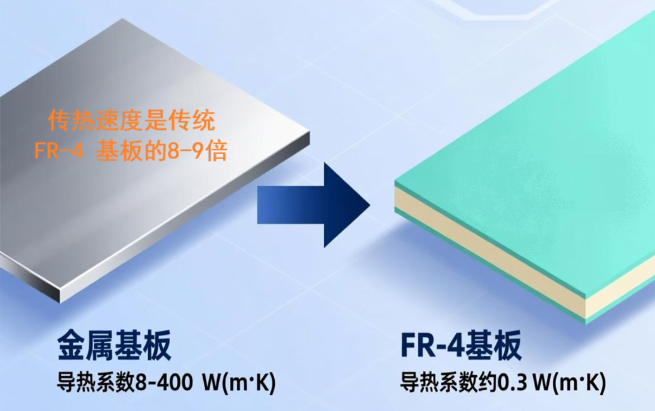
Exceptional Thermal Performance (Core Advantage): This is the defining characteristic that distinguishes metal-core PCBs from traditional organic substrates. Their thermal conductivity typically ranges from 8 to 400 W/(m·K), far surpassing that of FR-4 substrates (approximately 0.3 W/(m·K)), enabling heat transfer rates up to 8–9 times faster than FR-4. They rapidly conduct heat generated by high-heat-flux components such as LED chips, power modules, and CPUs into the metal substrate body, which then dissipates it into the environment via supporting structures like heat sinks or chassis, significantly lowering component operating temperatures and effectively enhancing device reliability and service life.
Superior Mechanical and Physical Properties: Metal-core PCBs offer exceptional mechanical strength and dimensional stability, with outstanding resistance to bending and vibration, making them suitable for harsh environments such as automotive and aerospace applications. Additionally, the metal layer itself acts as a natural electromagnetic shielding layer, effectively reducing electromagnetic interference (EMI) and enhancing the overall electromagnetic compatibility (EMC) of electronic systems.
Support for High-Power and High-Density Designs: Efficient thermal management overcomes the power limitations of traditional substrates, allowing designers to use higher-power components or adopt more compact layouts—achieving product miniaturization while maintaining high performance, perfectly aligning with current trends in electronics development.
2. Material Classification: Characteristics and Selection Logic for Aluminum, Copper, and Iron Substrates
Based on differences in core metal materials, metal-core PCBs are primarily categorized into aluminum-core, copper-core, and iron-core types. The selection process centers on achieving an optimal balance among performance, cost, and manufacturability. Their specific characteristics and application scenarios are summarized in the table below:
Substrate Type | Key Characteristics | Thermal Conductivity (Typical Value) | Application Scenarios |
|---|---|---|---|
Aluminum-Core | Best cost-performance ratio, good thermal conductivity, excellent machinability, moderate cost | 10–200 W/(m·K) | LED lighting, standard power modules, consumer electronics—currently the most widely used metal-core PCB |
Copper-Core | Best thermal performance, high electrical conductivity, but higher cost and greater processing difficulty | 200–400 W/(m·K) | Ultra-high heat-flux applications such as high-power LEDs, high-frequency RF modules, and premium power supplies where performance is paramount |
Iron-Core | Exceptional mechanical strength, excellent electromagnetic shielding, moderate thermal conductivity, lower cost | 8–50 W/(m·K) | Applications with special requirements for structural strength and EMI shielding, such as automotive electronics and industrial control equipment |
Note: In the vast majority of applications seeking a balance between thermal performance and cost, aluminum-core substrates are the first choice; copper-core substrates are reserved for extreme thermal demands; and iron-core substrates are tailored for specialized needs involving structural strength and electromagnetic shielding.
3. Structural Analysis: Classic "Sandwich" vs. Innovative "Thermal-Electrical Separation" Designs
(1) Classic Three-Layer "Sandwich" Structure
Standard metal-core PCBs employ a typical three-layer laminated structure, arranged from top to bottom as follows:
Circuit Layer: Typically formed by etching electrolytic copper foil into circuit patterns, this layer serves as the core functional layer for electrical interconnections. In high-power applications, copper foil thickness is increased from the standard 1 oz (35 μm) to as much as 8 oz (280 μm) to handle high current loads and prevent overheating damage.
Insulating Dielectric Layer: This is the technological heart of metal-core PCBs and also the thermal bottleneck. Positioned between the circuit layer and the metal base, it must simultaneously provide high electrical insulation and high thermal conductivity. It is typically composed of polymer matrices—such as epoxy resin or polyimide—filled with ceramic powders (e.g., alumina or boron nitride). Its thickness (typically 50–200 μm) and thermal conductivity directly determine the board’s overall thermal efficiency. Currently, high-performance aluminum-core PCBs achieve dielectric layer thermal conductivity of 1.0–10 W/(m·K).
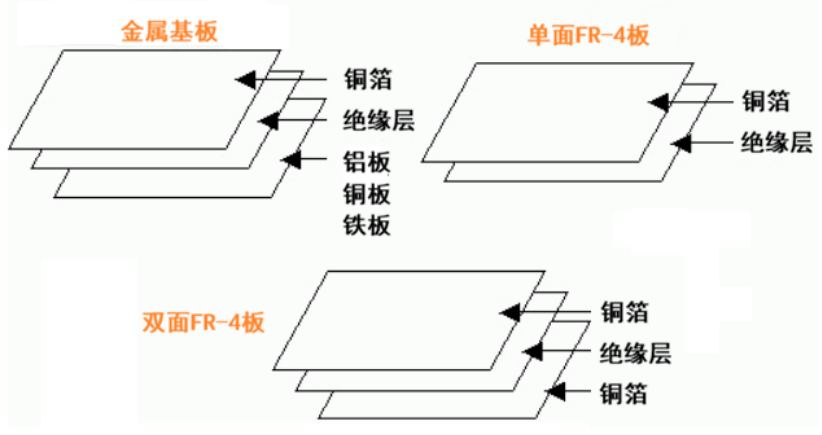
Metal Base Layer: Serving as the primary thermal conduction path and mechanical support, the material selection follows the classification outlined earlier, primarily responsible for heat dissipation and structural integrity.
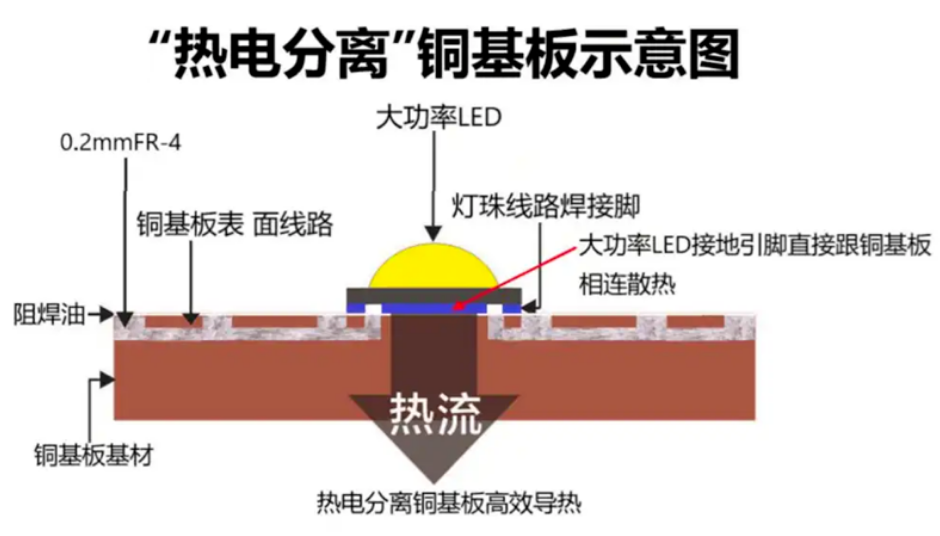
(2) Innovative "Thermal-Electrical Separation" Structure
To overcome the thermal resistance bottleneck imposed by the insulating dielectric layer, the industry has developed the advanced "thermal-electrical separation" structure. Its core concept is the physical separation of a component’s electrical connection pins from its thermal pad: the pins remain soldered onto conventional FR-4 or resin areas to ensure stable electrical connections, while a metal thermal pad (typically a copper block) is directly embedded into the substrate, forming a highly efficient thermal path that connects directly to the metal base.
Compared to the traditional sandwich structure, "thermal-electrical separation" achieves a qualitative leap in thermal performance, especially suited for ultra-high heat-flux applications such as COB-packaged LEDs and high-frequency, high-power modules, minimizing the core temperature of components to the greatest extent possible.
4. Application Fields and Scenario-Specific Requirements
Leveraging their unique thermal and mechanical advantages, metal-core PCBs have been widely adopted across various sectors with stringent thermal management and reliability requirements. The core demands vary significantly across industries, driving the diversified evolution of metal-core PCB technologies, as detailed in the table below:
Application Field | Core Requirements | Typical Products |
|---|---|---|
LED Lighting | Stable thermal performance, high cost-effectiveness, long lifespan | LED streetlights, automotive LED headlights, high-power indoor lighting, specialty lighting |
Automotive Electronics | High reliability, vibration resistance, high-temperature tolerance, electromagnetic compatibility | On-board power supplies, electronic control units, LED headlights, Battery Management Systems (BMS) |
New Energy Equipment | Ultra-high thermal efficiency, high voltage endurance, aging resistance | New energy vehicle "three-electric" systems, photovoltaic inverters, energy storage systems |
Telecommunications & Data Centers | High-frequency compatibility, efficient thermal dissipation, dimensional stability | 5G base station RF units, AI servers, switches, routers |
Aerospace & Medical | Ultimate reliability, resilience in harsh environments, precision thermal management | Avionics, medical imaging equipment, portable medical devices |
Leveraging mature metal-core PCB manufacturing capabilities,PCBPP has achieved large-scale deployment across multiple sectors, delivering benchmark solutions tailored to industry-specific needs and transforming process advantages into end-product competitiveness, as illustrated below:
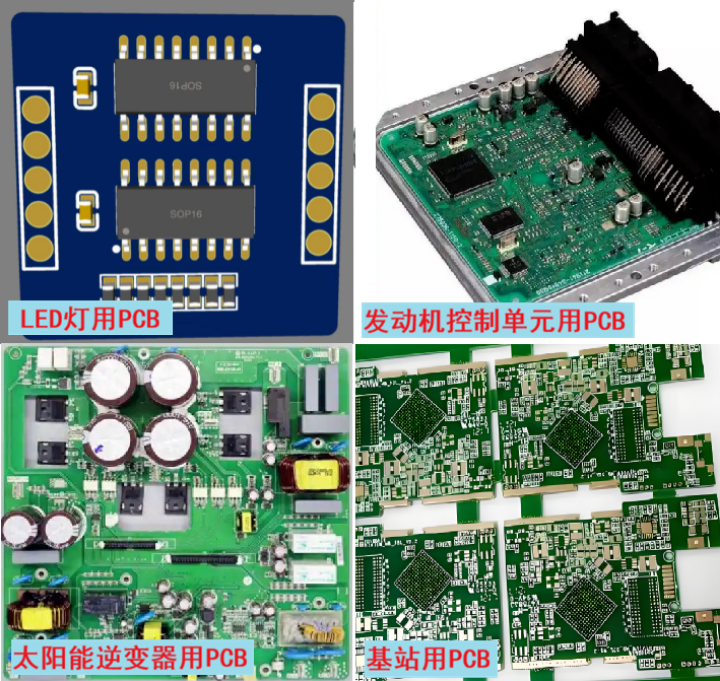
Case Study 1: LED Lighting – High-Power LED Streetlight Substrate Solution: Addressing the core demands of outdoor LED streetlights—stable thermal performance, high cost-effectiveness, and long service life—PCBPP selected high-thermal-conductivity aluminum-core substrates (25–50 W/(m·K)) combined with customized lamination and surface passivation processes to supply mass-produced substrates to a leading domestic lighting manufacturer. This solution effectively resolved issues of uneven heat dissipation and poor weather resistance, reducing LED chip operating temperatures by 15–20°C, extending lamp lifespan beyond 50,000 hours, and maintaining substrate defect rates below 0.2%. The solution is now deployed in over 1 million units annually across municipal and highway lighting projects nationwide.
Case Study 2: Automotive Electronics – Substrates for Automotive LED Headlights and BMS: Targeting the stringent automotive requirements for high reliability, vibration resistance, and high-temperature tolerance, PCBPP supplies dedicated metal-core substrates for LED headlights and Battery Management Systems (BMS) to a renowned automaker. Aluminum-core substrates are used for LED headlights, while high-strength iron-core substrates (balancing EMI shielding and structural stability) are employed for BMS. Through precision drilling (minimum hole diameter: 0.2 mm) and vacuum lamination, the substrates reliably operate under extreme conditions (-40°C to 125°C), achieving a soldering yield of over 99.8% and effectively mitigating risks of delamination and adhesive failure. Over 500,000 sets have been delivered for both new energy and internal combustion engine vehicles.
Case Study 3: New Energy – High-Power Substrates for Photovoltaic Inverters: To meet the ultra-high thermal efficiency and high-voltage endurance demands of photovoltaic inverters, PCBPP provides customized copper-core substrates (200–300 W/(m·K)), optimizing dielectric layer thickness (100–150 μm) and applying high-frequency-compatible surface treatments. This solution resolves thermal bottlenecks in high-power modules, increasing inverter power density by 20% and maintaining thermal resistance below 0.8°C/W, ensuring stable operation in large-scale solar farms. PCBPP is now a core supplier to multiple PV manufacturers, with annual shipments exceeding 300,000 units.
5. Special Considerations in Manufacturing and Testing
While the manufacturing process for metal-core PCBs resembles that of standard PCBs, the presence of the metal layer introduces greater complexity in processing and quality inspection, demanding higher technical precision. As an industry-leading PCB manufacturer, PCBPP has developed a mature process system that effectively addresses these challenges, establishing comprehensive, high-precision capabilities across all metal-core PCB types to meet mainstream and high-end industry requirements.
(1) Core Manufacturing Challenges
High Processing Difficulty: Machining operations such as drilling and V-CUT scoring on metals—especially hard materials like iron and copper—require specialized tools and precise process parameters. This not only increases processing costs but also accelerates tool wear and imposes stricter demands on equipment accuracy. PCBPP employs high-precision CNC equipment with custom tooling and optimized parameters, enabling accurate drilling and V-CUT scoring across aluminum, copper, and iron substrates—with minimum hole diameters down to 0.2 mm and cutting tolerances within ±0.05 mm—effectively resolving industry-wide issues like deformation and burrs to meet high-precision assembly needs.
Critical Lamination Process: Lamination is pivotal to thermal performance and reliability. Ensuring strong, bubble-free bonding between the dielectric layer, metal base, and copper foil under high temperature and pressure—without delamination or adhesive failure—is the core control point. PCBPP uses imported lamination equipment, optimized thermal-pressure profiles, and vacuum lamination technology to achieve tight adhesion, keeping delamination and adhesive failure rates below 0.3%. The company stably produces high-performance substrates with dielectric thicknesses of 50–200 μm and thermal conductivity of 1.0–10 W/(m·K), meeting premium thermal demands.
Surface Treatment Requires Compatibility: Surface treatments must prevent chemical reactions between the metal and processing chemicals (e.g., corrosion of aluminum). Specialized processes like passivation or tin plating are essential to ensure corrosion resistance and solderability. PCBPP offers comprehensive surface treatment options—including passivation, tin plating, and immersion gold—with corrosion-resistant processes specifically optimized for aluminum-core substrates, achieving soldering yields above 99.8% and meeting reliability requirements for harsh environments like automotive and new energy applications.
(2) Stricter Testing Standards
To guarantee performance stability and reliability, metal-core PCBs undergo more comprehensive and stringent testing than standard PCBs. Key inspection items include:
Thermal Performance Testing: Using thermal imaging cameras or thermocouples to measure thermal resistance and actual heat dissipation—this is a mandatory test that directly validates thermal capability. PCBPP employs professional thermal testing equipment capable of precisely measuring thermal conductivity and resistance with accuracy up to ±0.1 W/(m·K), ensuring every batch meets design specifications.
Insulation Reliability Testing: High-voltage tests and high-temperature/high-humidity reverse-bias tests verify the dielectric layer’s insulation integrity, preventing insulation failure during long-term use.
Adhesion Strength Testing: Evaluates the peel strength between the metal layer, dielectric layer, and circuit layer to prevent delamination and ensure structural stability.
Precision Dimensional and Warpage Inspection: Due to differing coefficients of thermal expansion (CTE) between metal and organic materials, board warpage is a common issue. Warpage must be closely monitored to ensure dimensional accuracy for assembly. PCBPP uses high-precision inspection equipment for full-check warpage and dimension control, maintaining warpage below 0.5% to meet the demands of high-precision electronics assembly.
6. Market Status and Future Trends
(1) Market Status: Steady Growth, with China Leading Globally
The global metal-core PCB market is experiencing steady growth, with expanding scale. Industry forecasts project the global market to grow from approximately $27.6 billion in 2024 at a CAGR of 2.3% to $31.7 billion by 2030. China stands out as one of the fastest-growing markets globally, with an expected CAGR of 4.5% over the same period, serving as a key driver of worldwide expansion.
(2) Key Growth Drivers
Ongoing Penetration and Upgrading of LED Lighting: The widespread adoption of high-power, high-luminance automotive and specialty LED products remains the largest and most stable demand source, continuously fueling market growth.
Explosive Growth of New Energy Vehicles: The "three-electric" systems (battery, motor, controller) in NEVs generate substantial heat, creating surging demand for high-efficiency thermal management PCBs—a core engine of market expansion.
Accelerated 5G and Data Center Deployment: The thermal demands of high-power RF units in 5G base stations and high-compute chips in AI servers are driving demand for high-performance metal-core PCBs and complementary high-frequency, low-loss materials (e.g., M6, M8 grade).
Trends Toward Miniaturization and Higher Power Density: The relentless pursuit of thinner, lighter, and more powerful devices in consumer electronics and medical equipment intensifies the need for thermal management in compact spaces, further broadening the application scope of metal-core PCBs.
(3) Future Technological Trends
Continuous Innovation in Materials and Structures: Direct thermal paths like "thermal-electrical separation" will become more prevalent; dielectric materials will evolve toward higher thermal conductivity (>10 W/m·K) and lower thermal resistance. Meanwhile, ceramic substrates—with superior thermal conductivity, insulation, and thermal stability—will increasingly complement and compete with high-end metal-core PCBs in ultra-high heat-flux applications.
Integration and Multi-Functionality: Trends toward integrated designs combining metal-core PCBs with heat sinks, enclosures, and heat pipes are accelerating, shifting the offering from standalone substrates to system-level thermal solutions for enhanced overall efficiency.
Enhanced Process Precision and Automation: To meet complex design demands like multilayer metal-core PCBs and embedded components, manufacturing will advance toward higher precision and automation, improving yield and performance consistency while reducing costs. PCBPP has pioneered automation upgrades, implementing end-to-end automated control—from material handling and drilling to etching, lamination, and inspection—supported by MES production management systems for real-time monitoring of critical parameters. This ensures consistent product performance with yields stably above 98.5%, while enabling mass production of multilayer and thermal-electrical separation metal-core PCBs to support industry innovation.
7. Conclusion
In summary, metal-core PCBs have evolved from a specialized thermal solution into a foundational enabler of modern high-power, high-reliability electronics. From LED streetlights illuminating cities to new energy vehicles powering the future and 5G base stations building the digital world, metal-core PCBs are ubiquitous—silently fulfilling their critical mission of thermal management.
Faced with increasingly demanding thermal challenges in future electronics, metal-core PCB technology will continue advancing in materials, structures, and processes, co-evolving with emerging solutions like ceramic substrates to provide a robust "thermal foundation" for electronic innovation. For electronics engineers, deeply understanding the characteristics, selection logic, and application boundaries of metal-core PCBs—and skillfully leveraging their thermal and mechanical advantages—will become essential for designing high-performance, reliable products, propelling electronics toward higher power, smaller size, and longer lifespans.
trending news
Contact Us