


Sorry, no sales person is available right now to take your call. Pls leave a message and we will reply to you via email as soon as possible.
Home/ PCB News/ Ceramic Substrates: The Core Power Driving the Development of AI and Humanoid Robots
Ceramic Substrates: The Core Power Driving the Development of AI and Humanoid Robots
2026-03-03
In spring 2026, from the agile and lifelike humanoid robots on the Spring Festival Gala stage to DeepSeek's breakthroughs in large-model computing power, artificial intelligence is rapidly permeating the physical world and being deployed across countless industries. However, whether it’s the continuous operation of cloud-based computing clusters or the precise movements of humanoid robot joints, both face dual challenges of thermal management efficiency and precision control. As a seasoned manufacturer with years of expertise in ceramic substrates, BAI NENG YUN BOARD’s core products—such as DPC and TFC—though hidden upstream in the industrial chain, serve as indispensable “invisible cornerstones” in this technological transformation thanks to their exceptional thermal conductivity and precision.
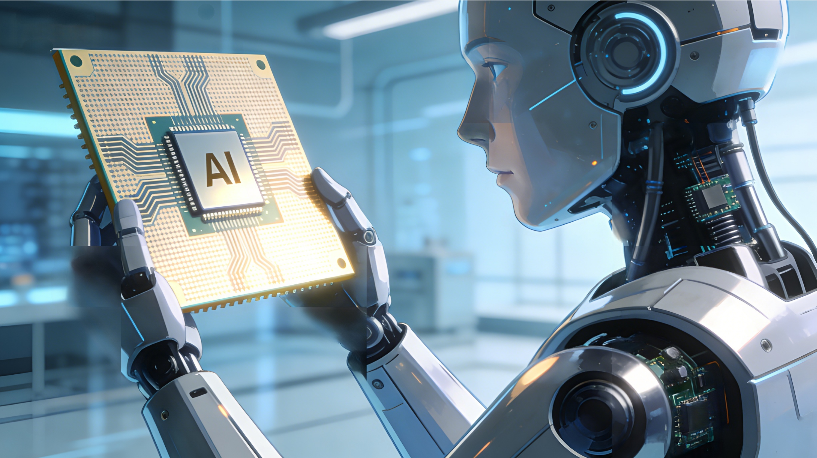
The "Heart" of AI Is Burning: Solving Thermal Challenges Amid Surging Computing Power
The competition in artificial intelligence is fundamentally a battle of computing power. As AI models evolve from hundreds of billions to trillions of parameters, data centers supporting them are encountering unprecedented “thermal shock,” making heat dissipation a critical bottleneck limiting further computing breakthroughs.
In the field of optical modules, to meet the demand for low-latency, high-bandwidth data transmission within AI clusters, module speeds are rapidly advancing toward 800G and even 1.6T. However, speed and power consumption are inherently correlated—the higher the speed, the more heat generated during operation. Traditional PCB substrates suffer from significant signal loss under high-frequency, high-speed conditions and lack sufficient thermal conductivity to manage the heat from high-power components, often leading to overheating and system failure.
DPC ceramic substrates offer an effective solution to this dilemma. Utilizing precision electroplating processes, they enable ultra-fine circuit patterning with line widths/spaces of 50–70 μm, ensuring stable signal transmission. More importantly, leveraging the superior thermal properties of ceramic materials—with aluminum nitride (AlN) achieving thermal conductivity exceeding 170 W/mK—they rapidly dissipate heat generated by lasers and driver chips within optical modules, guaranteeing stable, continuous operation even in high-density computing environments and safeguarding AI’s relentless pursuit of greater computing power.
Meanwhile, to further overcome signal transmission bottlenecks, the industry is aggressively advancing CPO (Co-Packaged Optics) technology, which integrates optical and electrical chips onto the same substrate to bring them into “intimate proximity.” This approach imposes stringent requirements on substrate precision, flatness, and coefficient of thermal expansion (CTE) matching. TFC products, with their ultra-high surface flatness and CTE closely aligned with that of chips, have emerged as the ideal platform for CPO packaging, laying a solid foundation for the high integration of optoelectronic devices.
The "Senses" and "Joints" of Humanoid Robots: Core Support for Precision Motion
If AI data centers represent the “cloud-based brain” driving industrial transformation, humanoid robots are the “physical embodiment” bringing artificial intelligence into the real world. To achieve human-like agility and precise perception, robots rely heavily on two core components: LiDAR and miniature sensors—and ceramic substrates are key enablers ensuring their stable operation.
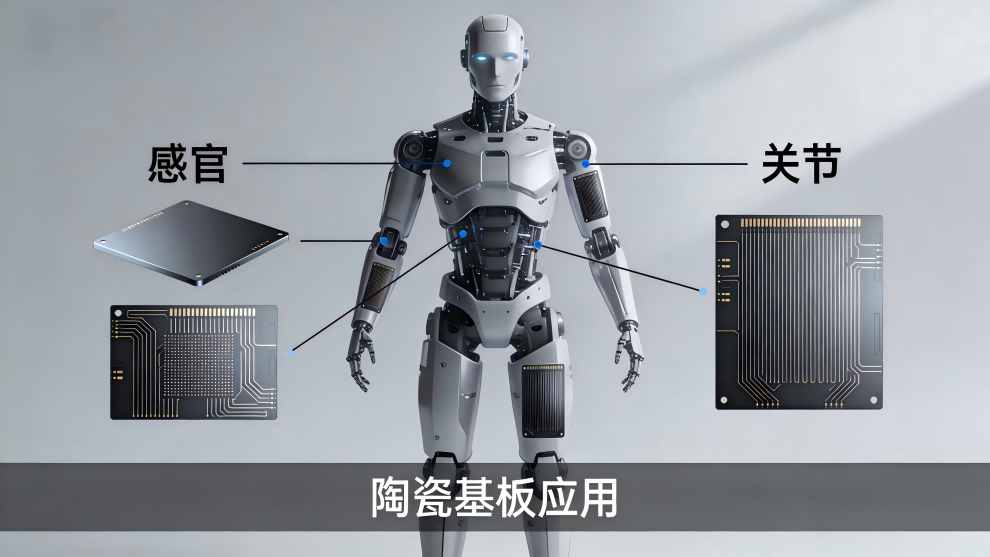
LiDAR acts as the robot’s “eyes,” allowing it to “see” the world clearly and enabling precise movement. The reason humanoid robots could flawlessly perform complex maneuvers like parkour and backflips on the 2026 Spring Festival Gala stage without collisions lies in their powerful environmental perception capabilities. At the heart of this perception, the VCSEL laser arrays inside LiDAR generate substantial heat during high-speed operation. Inadequate heat dissipation causes wavelength drift, directly compromising ranging accuracy. Aluminum nitride (AlN)-based DPC ceramic substrates, with their exceptional thermal conductivity, have become the preferred solution for LiDAR packaging in humanoid robots, maintaining stable laser wavelengths even under high temperatures and providing reliable perceptual support for precise robotic actions.
Miniature sensors function as the robot’s “peripheral nerves.” Humanoid robots require force and tactile sensors distributed throughout their bodies to accurately sense interactions with the environment. These sensors must integrate complex circuits within extremely limited space, demanding extraordinary substrate precision. Here, TFC thin-film ceramic substrate technology plays a pivotal role: compared to DPC, TFC offers superior process precision, with line widths controllable below 10 micrometers—ideal for low-current, high-precision signal transmission. This enables accurate capture of subtle force variations and lossless signal delivery to the robot’s “brain.” In the future, as electronic skin becomes fully integrated into humanoid robots, TFC substrates will serve as the ideal underlying circuit platform, further enhancing robotic perception accuracy and human-like capabilities.
Future Industrial Opportunities: The Evolution of Ceramic Substrates from “Optional” to “Essential”
Whether AI computing clusters advance toward higher power density and integration, or humanoid robots evolve toward greater precision and agility, the thermal and signal integrity challenges of electronic components can no longer be ignored. Traditional organic substrates (e.g., FR-4) have inherent limitations in high-temperature resistance, high-frequency loss, and hermeticity, making them unsuitable for high-end applications. Consequently, the shift toward “essential” adoption of ceramic substrates is becoming increasingly evident.
From a thermal management perspective, the ever-increasing heat flux density of core components like AI chips and LiDAR has transformed the high thermal conductivity of ceramic substrates from a “differentiating advantage” into a “hard requirement” for high-end applications—directly determining device stability and service life. In terms of reliability, the constant thermal cycling caused by frequent joint movements in humanoid robots demands substrates with excellent thermal shock resistance and structural stability. DPC and TFC substrates, with CTEs perfectly matched to those of chips, effectively mitigate thermal stress and significantly extend equipment lifespan. Regarding integration, trends like CPO and optoelectronic co-packaging require high-density wiring within minimal footprints—a unique strength of photolithography-based ceramic substrates such as TFC, which can support the high-integration evolution of next-generation devices.
In this wave of industrial transformation as AI extends into the physical world, ceramic substrates are transitioning from behind-the-scenes “supporting components” to front-and-center “core enablers.” With their fundamental advantages in thermal management, precision, and reliability, they are becoming a critical force powering future technologies like AI and humanoid robotics—ushering in a new era where ceramic substrates evolve from “optional” to “essential.” As a leading domestic manufacturer of ceramic substrates, BAI NENG YUN BOARD leverages deep process expertise to deliver comprehensive and efficient ceramic substrate manufacturing capabilities that firmly support this industrial upgrade. Proficient in core technologies including DPC, DBC, AMB, and TFC, the company stably achieves line width control of 50–70 μm with DPC and under 10 μm with TFC. Supported by mature metallization and high-temperature bonding techniques, it ensures outstanding thermal performance and reliability. Moreover, through 36 full-process inspection steps and automated production equipment, BAI NENG YUN BOARD maintains a yield rate above 99%, enabling stable mass production of aluminum nitride ceramic substrates with thermal conductivity exceeding 170 W/mK—precisely meeting the demanding requirements of high-end applications such as AI optical modules and robotic LiDAR, and accelerating the “essential adoption” of ceramic substrates through proven, mature processes.
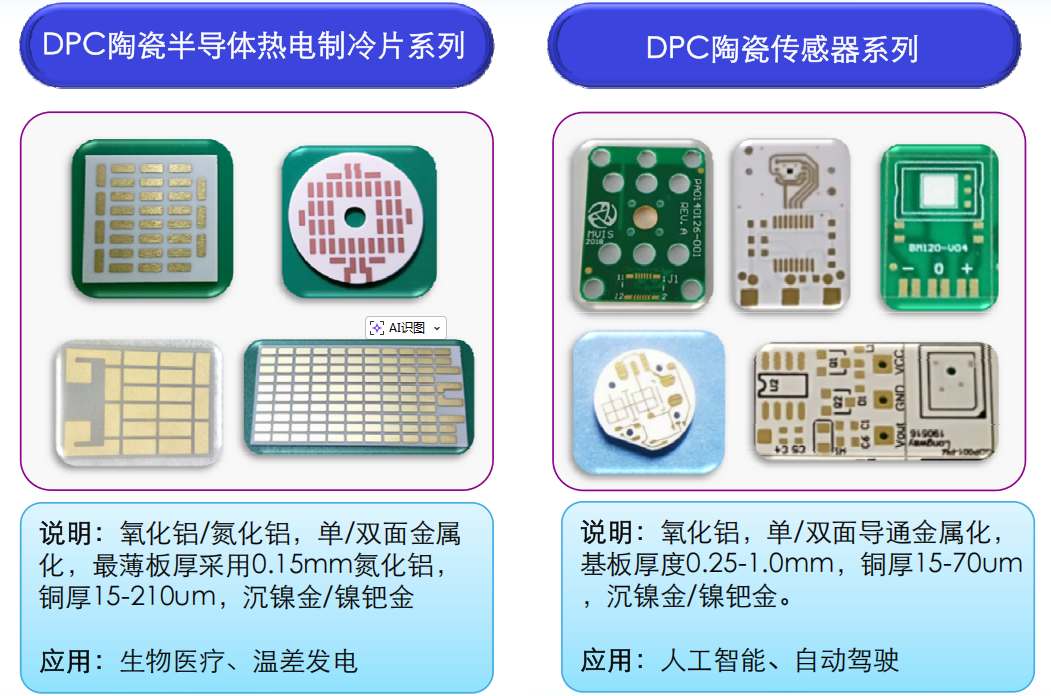
BAI NENG YUN BOARD Ceramic Substrate Showcase for AI Applications
trending news
Contact Us