



Sorry, no sales person is available right now to take your call. Pls leave a message and we will reply to you via email as soon as possible.
Home/ Industry News/ Understanding POE Power Transformers – This Article Has Got You Covered – VOOHU Wohu Electronics
Understanding POE Power Transformers – This Article Has Got You Covered – VOOHU Wohu Electronics
2026-05-28
In PoE power system design, the selection of PSE and PD controllers often receives the most attention. However, in practical engineering, whether the power transformer and network transformer are properly matched directly determines power efficiency, thermal performance, and long-term reliability. Different IEEE standards (af/at/bt) correspond to varying power levels, current-carrying capacities, and thermal requirements. The transformer’s core material, winding structure, isolation voltage rating, and DC bias characteristics must all strictly align with the specific application conditions. Improper component selection can lead to reduced efficiency, excessive temperature rise, or even equipment damage.
Wohu Electronics provides a complete transformer solution tailored for PoE applications, covering the full range of af/at/bt power levels. We also offer tested reference designs and component matching recommendations to help engineers balance power stability and EMC performance while reducing system debugging risks.
What is a PoE Power Transformer?
Definition
A PoE transformer is a core component in a Power over Ethernet (PoE) system, enabling standard Ethernet cables to simultaneously transmit data and deliver stable power to remote devices.
Main Components
PSE (Power Sourcing Equipment)
The PSE initiates DC power delivery and supplies power via data pairs (1/2, 3/6) or spare pairs (4/5, 7/8), depending on the applicable standard (af/at/bt).
Typical applications: PoE switches, PoE injectors, PoE media converters
PD (Powered Device)
The PD passively receives DC power. Through a PD controller and a DC-DC converter, it steps down the 37V–57V DC voltage from the secondary side to the operating voltage required by the device (e.g., 5V, 12V, 3.3V).
Typical applications: PoE IP cameras, wireless APs, VoIP phones, PoE lighting fixtures
Main Functions of the PSE Controller:
The PSE controller only outputs 48V after detecting that the connected load meets the power delivery criteria. This mechanism ensures that devices receive adequate power for stable operation while effectively preventing damage or performance degradation caused by insufficient or excessive power supply.
Main Functions of the PD Controller:
The PD controller supports hot-swapping, allowing new PD devices to be connected without powering down the system. Upon connection, the PD controller automatically configures itself as a standard PoE load and delivers power from the source to the internal circuitry with maximum efficiency, enhancing the flexibility and scalability of the power system.
Working Principle of PoE Power Transformers:
Essentially, network transformers and power transformers perform distinct but complementary roles—achieving both data isolation and voltage conversion.
In network equipment, transformers are generally categorized into two types: network transformers and power transformers, each serving different purposes and occupying different positions.
The network transformer is located at the network interface, between the PHY chip and the RJ45 connector. Its functions include: (1) transmitting high-frequency data signals while providing filtering, electrical isolation, and impedance matching; and (2) coupling DC power through an internal center tap to enable simultaneous transmission of DC power and high-speed data signals.
The power transformer resides within the device’s internal DC-DC power circuit. Its primary role is energy conversion: when the switch turns on, the primary winding stores energy in the form of a magnetic field; when the switch turns off, this magnetic energy is transferred to the secondary winding and converted into low-voltage DC output (e.g., 5V, 12V) required by the device.
Relationship with PSE / PD
In a PoE power system, PSE devices (e.g., PoE switches) primarily contain network transformers, which couple 48V DC onto Ethernet cables (via data or spare pairs) while transmitting data. PD devices (e.g., PoE cameras), on the other hand, incorporate both network transformers and PoE power transformers: the network transformer extracts 48V DC from the data lines, and the PoE power transformer further steps it down to 5V or 12V to power internal chips.
PoE Power Standards:
PoE power transformers come in different power ratings corresponding to three main IEEE 802.3 standards. Selection should be based on the power requirements of the target device.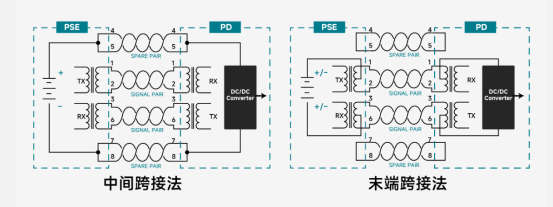
Mid-Span Method:
Uses the unused wire pairs (4/5 and 7/8) in Ethernet cables to transmit DC power. Data and power share the same cable by operating at different frequencies, enabling signal and power multiplexing.
PoE+ (IEEE 802.3at) fully inherits and remains compatible with the two wiring schemes defined in PoE (IEEE 802.3af), without any changes.
End-Span Method:
Uses the data-carrying pairs (1/2 and 3/6) to simultaneously transmit both data and DC power.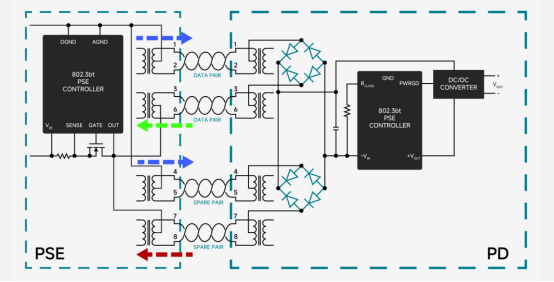
The IEEE 802.3bt standard defines power delivery over all four twisted pairs (8 conductors) to meet market demand for higher-power and more efficient PoE capabilities. It enables:
Compatibility with 10GBASE-T at maximum data rates;
Delivery of 40W minimum to 90W maximum power at the PD side.
PoE Power Standards
1. PoE Standards and Power Levels
Type 1 (802.3af)
Class 1: PSE supplies 4W, PD receives 3.84W
Class 2: PSE supplies 7W, PD receives 6.49W
Class 3: PSE supplies 15.4W, PD receives 13W
Type 2 (802.3at)
Class 4: PSE supplies 30W, PD receives 25.5W
Type 3 (802.3bt)
Class 5: PSE supplies 45W, PD receives 40W
Class 6: PSE supplies 60W, PD receives 51W
Type 4 (802.3bt)
Class 7: PSE supplies 75W, PD receives 62W
Class 8: PSE supplies 90W, PD receives 71.3W (Note: “713 W” in the chart appears to be a typographical error; the correct value is 71.3W)
2. Power Delivery Methods
Type 1 & Type 2: Support 2-pair power delivery only
Type 3 & Type 4: Support either 2-pair or 4-pair power delivery
Class 5 and above (Type 3/4): Always use 4-pair power delivery
Recommended PoE Power Transformers
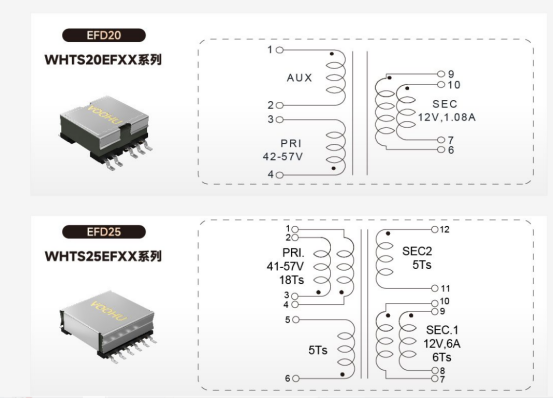
To address diverse power levels and application scenarios, Wohu offers six PoE power transformer series—EP7, EP10, EP13, EFD15, EFD20, and EFD25—fully compliant with IEEE 802.3af/at/bt standards, meeting power needs ranging from IP surveillance and wireless APs to industrial gateways and digital signage.
EP7 Series (ST07XXWH):
Compact size, low power; typical output 5V/1A; ideal for VoIP phones and single-port PoE PD devices.
EP10 Series (ST10XXWH):
Medium power; typical output 13.5V/0.75A; suitable for small wireless APs and indoor cameras under af/at standards.
EP13 Series (ST13XXWH):
Power range 13W–25W; configurable outputs such as 5V/2.6A; widely used in PTZ cameras and industrial sensors.
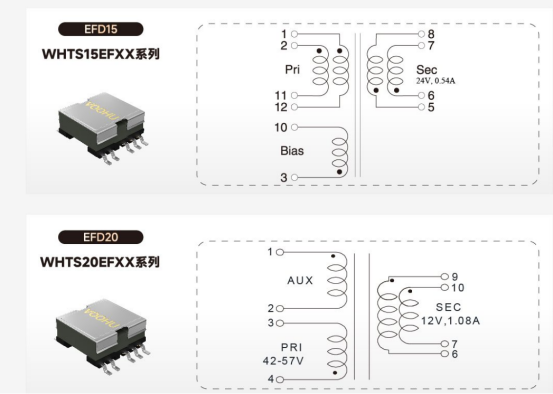
EFD15 Series (WHTS15EFXX):
Features a flat-core design with low profile; typical output 24V/0.54A; ideal for height-sensitive applications like industrial gateways and PLCs.
EFD20 Series (WHTS20EFXX):
Supports higher power (up to 100W); output 12V/1.08A; compatible with bt-standard large-format digital signage and multi-port PD devices.
EFD25 Series (WHTS25EFXX):
High-power model; capable of 12V/6A output; meets bt Type 4 (90W+) requirements for applications such as vehicle-mounted charging stations and AI edge computing nodes.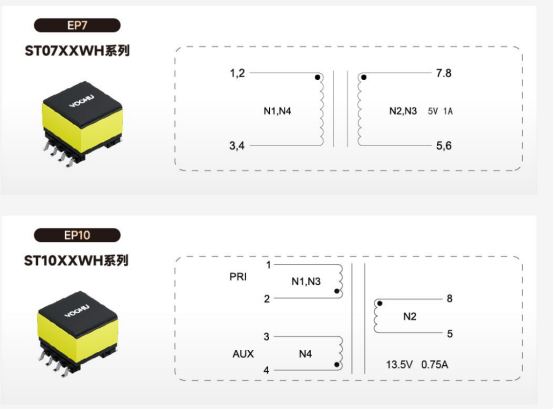
Typical Application Scenarios
IP Surveillance (Outdoor PTZ Cameras):
PSE requires ≥30W per port (at standard) with stable power delivery over 100 meters; PD requires wide UVLO (undervoltage lockout) range, surge protection ≥6kV, and efficiency >85%.
Wireless APs (High-Density Deployment):
PSE requires sufficient total power budget, support for at/bt standards, and per-port independent reboot capability; PD requires precise signature resistance and accurate classification current (Class 4 or higher).
VoIP Phones:
PSE requires ≥15.4W per port (af standard) with backward compatibility for legacy af devices; PD requires low UVLO threshold (for compatibility with older PSEs) and low standby power consumption.
PoE Lighting:
PSE supports bt Type 3/4 with Autoclass automatic classification; PD supports short MPS (Maintain Power Signature) and fast dimming response.
Digital Signage (Large Displays):
PSE requires ≥60W per port (bt standard) with ≥30% total power headroom; PD requires DC-DC efficiency >90% and robust thermal design (e.g., metal enclosure).
Industrial Gateways/PLCs:
PSE requires industrial-grade wide temperature range, enhanced port isolation, and high surge immunity; PD requires wide input voltage range (extendable to 60V) and wide-temperature operation.
Frequently Asked Questions (FAQ)
1: What roles do Wohu Electronics’ PoE power transformers play in PSE and PD devices?
In PSE devices (e.g., PoE switches), Wohu’s network transformers couple 48V DC onto Ethernet cables (via data or spare pairs), enabling simultaneous data and power transmission. In PD devices (e.g., PoE cameras), Wohu’s network transformers extract 48V DC from the data lines, and Wohu’s PoE power transformers step it down to 5V/12V to power internal chips. Wohu offers the full EP7 to EFD25 series for both PSE and PD applications, with customizable turns ratios.
2: What are the key differences among IEEE 802.3 af/at/bt standards, and how does Wohu assist with component selection?
af (PoE): up to 15.4W; suitable for VoIP phones and low-power sensors.
at (PoE+): up to 30W, backward compatible with af; ideal for PTZ cameras and wireless APs.
bt (PoE++): up to 90W (Type 4), supports 10GBASE-T; designed for large digital signage and AI edge devices.
Wohu provides a full range of transformers covering all three standards, with the EFD20/EFD25 series fully supporting bt (90W+ output). Engineers can refer to Wohu’s online power compatibility charts or contact FAE for tailored selection advice.
3: What package series does Wohu offer for PoE transformers, and which power levels do they support?
Wohu offers six package series:
EP7 (ST07XXWH): compact size, ~5W typical; for VoIP phones.
EP10 (ST10XXWH): medium power (13.5V/0.75A); for small APs.
EP13 (ST13XXWH): 13–25W; configurable 5V/2.6A output; for PTZ cameras and sensors.
EFD15 (WHTS15EFXX): low-profile; 24V/0.54A; for industrial gateways and PLCs.
EFD20 (WHTS20EFXX): up to 100W; 12V/1.08A; for bt-compliant large displays.
EFD25 (WHTS25EFXX): high power; 12V/6A; meets bt Type 4 (90W+) for vehicle chargers and AI edge nodes.
All series support wide input voltage range (42–57V) and customizable turns ratios.
trending news
Contact Us