


Sorry, no sales person is available right now to take your call. Pls leave a message and we will reply to you via email as soon as possible.
Home/ Industry News/ The Real Pain Points of Smart Manufacturing: Hardware Surging Ahead, Software Anemic, Talent Inverted—China's Manufacturing Triple Scissors Gap
The Real Pain Points of Smart Manufacturing: Hardware Surging Ahead, Software Anemic, Talent Inverted—China's Manufacturing Triple Scissors Gap
2026-06-30
Recently, the BaiNeng Information team intensively visited four leading PCB manufacturing plants within 48 hours, conducting in-depth research into the current state of smart manufacturing implementation in the industry. During our on-site visits, we clearly observed the tangible achievements of hardware upgrades in China’s PCB manufacturing sector: automated equipment such as laser drilling machines, automatic lamination systems, AOI optical inspection devices, and AGV-based intelligent logistics solutions have become widely adopted and technologically mature. Leading factories routinely invest tens of billions—and sometimes even over one hundred billion RMB—in automation hardware alone, making the industry’s hardware modernization visibly evident.
However, beneath this surface-level automation boom, when we delved deeper into core aspects of enterprise production operations, data management, and intelligent decision-making, we encountered a profound structural dilemma across the industry: while domestic manufacturers’ hardware automation capabilities now rival global standards, their software-driven core competencies—such as digital operations, data governance, and AI-powered decision-making—lag significantly behind and represent critical weaknesses.
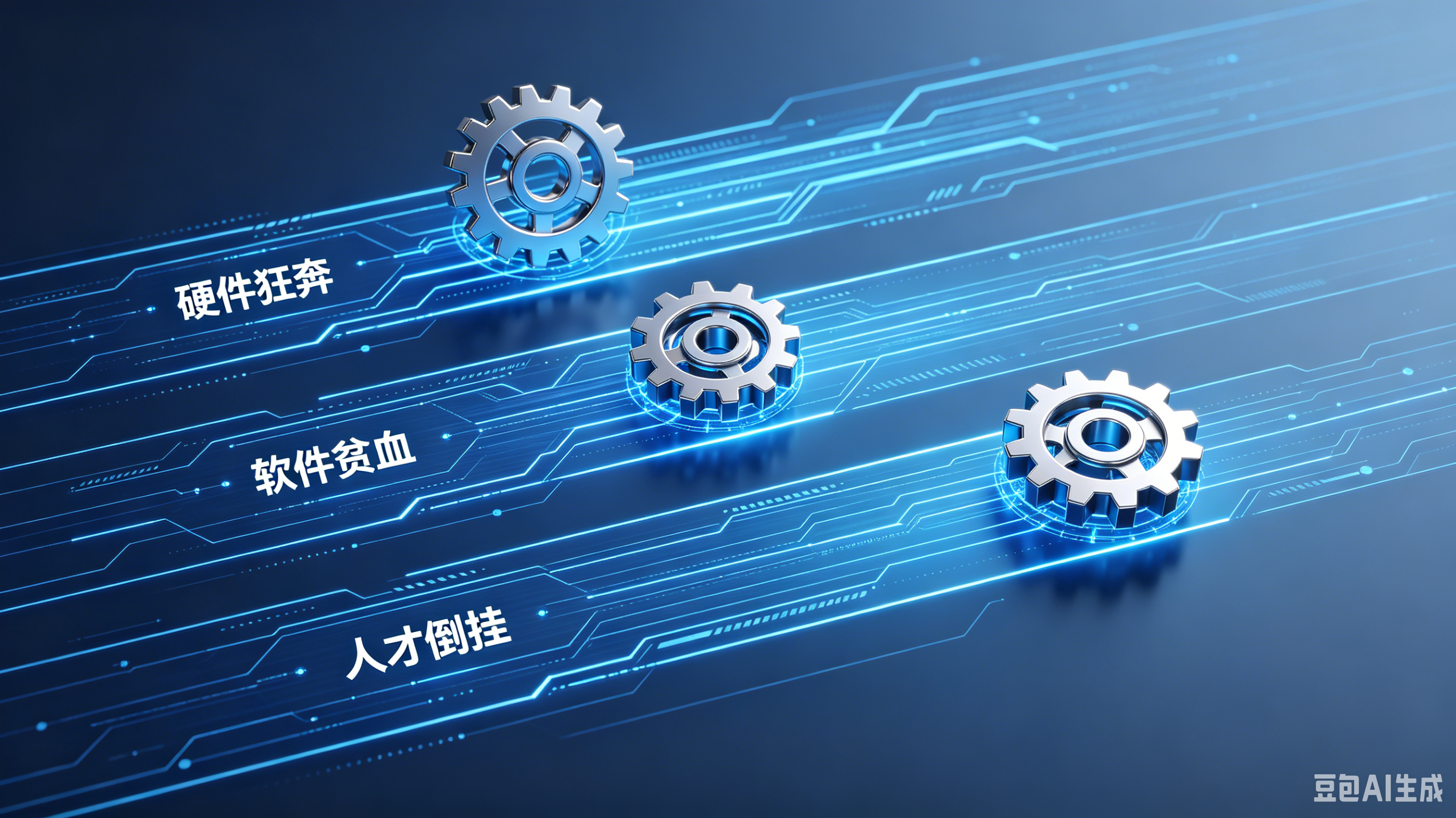
This stark imbalance—hardware racing ahead at full speed while software remains severely underdeveloped—has created a critical “scissors gap” that constrains China’s manufacturing sector from advancing toward higher-level smart manufacturing.
This is not an isolated issue unique to the PCB industry but rather the most common and pivotal pain point facing China’s broader manufacturing transformation and upgrade. Today, we openly share with every BaiNeng partner our authentic observations and deep reflections from this industry research, hoping to inspire collective progress and clarify our shared mission and direction forward.
I. The First Scissors Gap: Massive Hardware Investment vs. Extremely Limited Software Spending
1. Hardware Investment: Bold, Decisive, and Routinely Reaching Tens of Billions
PCB manufacturing is capital-intensive. Leading enterprises typically invest between RMB 2–5 billion per new plant, with large-scale projects exceeding RMB 10 billion. Companies consistently adopt the same rationale for hardware investment: if it boosts capacity or yield, decisions involving hundreds of millions or even billions can be made swiftly. A high-end HDI production line requires approximately RMB 800 million to RMB 1.2 billion in equipment investment; a single automated line for 5G/high-frequency boards costs around RMB 128 million. Hardware accounts for over 90% of total CAPEX (capital expenditure).
2. Software Investment: Marginalized, Dependent on Subsidies, and Under 5%
In sharp contrast, spending on software and digitalization typically ranges only between 1%–3%, rarely exceeding 5%. Even more concerning is the prevailing mindset:
(1) Misaligned perception: software is viewed as a “cost item,” whereas hardware is seen as an “asset item.”
(2) Reluctance to invest: companies would rather purchase another RMB 100-million piece of equipment than spend RMB 1 million on data governance.
(3) Comparative data: Chinese manufacturers broadly exhibit a “hardware-heavy, software-light” bias. PCB factories typically allocate only 0.5%–1.5% of revenue to IT budgets, compared to 3%–5% among internationally advanced enterprises.
Conclusion: Hardware investment operates at the “billion-RMB level,” while software investment remains at the “million-RMB level”—a gap of several hundred times. This represents the largest cognitive scissors gap.
II. The Second Scissors Gap: Senior Manufacturing Executives Earn High Salaries, While Digital Talent Is Undervalued and Underpaid
1. Manufacturing Executives: Industry Veterans, Core Decision-Makers, Earning Million-RMB Salaries
PCB manufacturing relies heavily on accumulated process expertise. Most senior executives possess 20–30 years of hands-on manufacturing experience and firmly control strategic direction and resources. Plant managers and directors typically earn RMB 500,000–800,000 annually; vice presidents earn RMB 800,000–1.5 million, with listed-company executives often earning several million RMB per year.
2. Digital Talent: Assigned Lower Ranks, Paid Half as Much, and Granted Minimal Influence
In stark contrast, digital/IT teams suffer from systemic undervaluation across rank, compensation, and authority:
(1) Low organizational rank: most factories lack a CIO (Chief Information Officer); the highest role is typically an IT manager (a junior management position).
(2) Low compensation: IT managers earn RMB 250,000–400,000 annually—only one-third to one-half of what manufacturing VPs earn. Data engineers are paid significantly less than process or equipment experts at equivalent levels.
(3) Weak influence: virtually no company assigns a VP or executive-level leader to directly spearhead its digital transformation strategy.
Conclusion: Those who understand production best don’t understand data, and those who understand data best hold no real authority. This dual inversion in organizational hierarchy and compensation directly blocks effective digital transformation.
III. The Third Scissors Gap: Near-Zero Data Capabilities Render Intelligent Operations Impossible
During our visits, we observed strong equipment automation—but virtually no capability in data extraction, modeling, or closed-loop problem resolution.
1. Coarse data granularity: only basic metrics like output volume and yield are tracked, with little to no fine-grained collection of equipment parameters, process variables, or energy consumption.
2. Absence of data modeling: no AI-driven yield prediction, anomaly alerts, or root-cause analysis exists.
3. No closed-loop issue management: there are no standardized, data-triggered workflows for handling anomalies.
4. Heavy reliance on experience: production and quality control depend overwhelmingly on “master craftsmen” rather than data-driven models.
Conclusion: Hardware forms the “intelligent body,” but data constitutes the “digital brain.” Without a brain, even the most advanced body can only achieve “automation,” not true “intelligence.”
IV. A Glimmer of Hope: Our Mission and Journey Ahead
Dear partners, amid the industry-wide bias of “prioritizing hardware over software” and the scarcity of specialized domestic software, BaiNeng Information’s independently developed iPCB and iPCB AI platforms were created precisely to bridge these scissors gaps. This is the very meaning and value of our daily work.
iPCB: As one of the few domestically developed PCB-specific industrial software platforms with independent intellectual property rights, it covers the entire workflow—including intelligent CAM, automated order review, and process modeling—to solve fundamental issues of fragmented data and inconsistent standards.
iPCB AI: It is not merely a “tool software” but rather the foundational infrastructure for intelligent operations in the PCB industry. Its mission is to enhance the sector’s core intelligent operational capabilities through high-granularity data extraction, AI-powered process modeling, yield prediction, and more—thereby truly empowering expensive automation hardware with data intelligence and upgrading “machine replacement” to “data-driven cognitive transformation.”
Amid the triple challenge of “scarce domestic software, foreign software lacking local adaptability, and enterprise reluctance to invest,” we have chosen to pursue what is difficult yet right—to build foundations with software, empower with data, and reconstruct operations with AI.
V. Conclusion: Our Future Is Determined by Our Mindset
In summary, the PCB industry—and indeed all of Chinese manufacturing—is currently facing three critical scissors gaps:
1. Investment Gap: Hardware spending reaches the billion-RMB scale, while software remains at the million-RMB scale—a difference of hundreds of times;
2. Talent Gap: Manufacturing executives earn million-RMB salaries, while IT professionals receive only one-third to one-fifth of that amount and remain organizationally marginalized;
3. Capability Gap: Equipment is advanced, yet data modeling and intelligent operations remain virtually non-existent.
This reveals a clear future trajectory: over the next 3–5 years, industry competition will no longer hinge on “who owns more expensive equipment,” but rather on “who possesses stronger data capabilities, smarter operations, and more advanced cognition.”
The mission of BaiNeng Information’s iPCB and iPCB AI is to leverage domestically developed specialized software and AI capabilities to help the industry close these scissors gaps—unlocking the true value of advanced hardware and enabling Chinese manufacturing to evolve from “catching up through automation” to “leading through intelligence.”
trending news
Contact Us