


Sorry, no sales person is available right now to take your call. Pls leave a message and we will reply to you via email as soon as possible.
Home/ Industry News/ STMicroelectronics solidifies its leading position in two key sectors with robust technical capabilities.
STMicroelectronics solidifies its leading position in two key sectors with robust technical capabilities.
2026-05-11
On the latest 7-day trending chart released by BAIIC Cloud, STMicroelectronics' STM8S003F3P6TR has once again firmly secured the top spot without any surprise. Why does this 8-bit microcontroller, launched years ago, continue to maintain its popularity in the rapidly evolving semiconductor market? From consumer electronics giants like Midea, Xiaomi, and Philips to industrial automation leaders such as Siemens and Schneider Electric—what key features have made it a go-to choice among engineers? This article will provide an in-depth analysis of this classic MCU’s industry value and market position by examining current market dynamics, technical specifications, real-world applications from renowned brands, and BAIIC Cloud’s supply chain advantages.
I. Product Overview: A Benchmark Entry-Level Embedded MCU
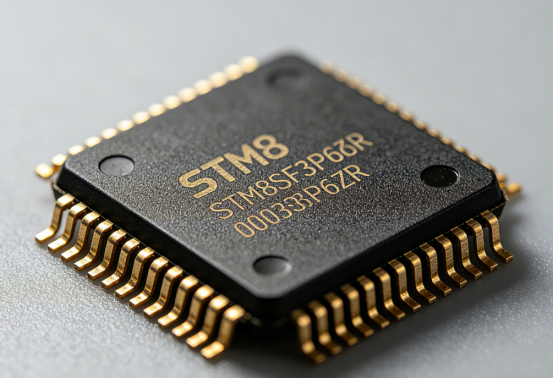
The STM8S003F3P6TR is part of STMicroelectronics’ STM8S Value Line of 8-bit microcontrollers. Built on a mature Harvard architecture with a three-stage pipeline design, it delivers a maximum clock speed of 16 MHz, specifically tailored for low-complexity, cost-effective control applications. Since its mass production launch, it has consistently dominated essential component selection lists across consumer electronics, smart home devices, and industrial control sectors thanks to its balanced performance, rich peripheral set, and exceptional cost efficiency. On BAIIC Cloud’s electronic component procurement platform, this model consistently ranks among the most-searched items monthly, serving clients ranging from leading appliance manufacturers like Midea and Gree to small- and medium-sized R&D enterprises, maker communities, and university laboratories—truly earning its status as a perennial favorite in embedded general-purpose MCUs.
(1) Core Specifications: Compact Yet Fully Equipped
As a mainstream entry-level 8-bit MCU, the STM8S003F3P6TR offers a streamlined yet highly practical configuration that precisely meets the demands of low-cost control scenarios:
Core Architecture: STM8 8-bit core with Harvard architecture and a three-stage pipeline, delivering high execution efficiency at 16 MHz, stable instruction execution, and strong noise immunity.
Memory Configuration: 8 KB Flash, 1 KB RAM, and 128-byte EEPROM—sufficient for storing standard control programs, temporary data processing, and retaining parameters during power loss.
Peripheral Resources: 5-channel 10-bit ADC, UART, SPI, I²C, multiple 16-bit timers, and PWM outputs—enabling signal acquisition, communication, and motor drive functions all on a single chip.
Power Supply & Consumption: Wide operating voltage range of 2.95V–5.5V with multiple low-power modes; standby current as low as 1 μA, suitable for both battery-powered and mains-powered devices.
Package & Temperature Range: Compact TSSOP-20 package with an industrial-grade temperature range of -40°C to +85°C, ideal for consumer, home, and general industrial PCB layouts.
Reliability: Integrated watchdog timer and brown-out reset; long flash endurance and extended data retention significantly reduce external circuit complexity. This well-balanced combination of performance, cost, power efficiency, and ease of use makes it the default choice for engineers working on cost-sensitive projects or mass-production designs.
(2) Technical Highlights: Core Competitive Advantages Within a Mature Architecture
Exceptional Cost Efficiency: As a flagship model in ST’s Value Line, the STM8S003F3P6TR maintains a consistently low unit price—significantly cheaper than comparable 32-bit MCUs. For major appliance brands like Midea, Joyoung, and Supor, bulk procurement drastically reduces per-unit material costs, directly boosting product profitability and market competitiveness. Ultra-Low Power Design: Multiple power-saving modes including halt and standby ensure minimal static power consumption—perfectly suited for battery-powered products such as Philips electric toothbrushes, Xiaomi earphone charging cases, and portable smart sensors, effectively extending overall device battery life. Mature & Comprehensive Development Ecosystem: Officially supported by ST’s STM8CubeMX configuration tool and full compiler environments including Keil and IAR, with abundant technical documentation and example code. Engineers at industrial firms like Siemens and Schneider Electric can quickly get up to speed, shortening development cycles and accelerating time-to-market. High Integration Saves Board Space: Integrated multi-channel ADC, standard communication interfaces, and PWM timer outputs eliminate the need for additional external chips, enabling complete functionalities like sensor data acquisition, LED dimming, motor control, and network communication—all while reducing PCB area and BOM costs.
II. Application Scenarios: Mass Adoption Across Multiple Industries by Leading Brands
Thanks to its reliability, cost-effectiveness, and mature ecosystem, the STM8S003F3P6TR spans four major sectors—consumer electronics, smart home, industrial control, and education/R&D—with widespread mass production adoption by numerous industry leaders.
(1) Consumer Electronics
Small household appliances represent the largest application segment for this MCU, with mainstream brands like Midea, Joyoung, Supor, and Bear extensively using it in air fryers, humidifiers, coffee makers,养生 kettles, and electric toothbrush main controllers. Its timers enable motor speed control, while its ADC handles temperature and button input—delivering intelligent control logic at minimal material cost.
In the smart home sector, entry-level products from Xiaomi, Philips, and Huawei—including smart plugs, smart bulbs, and thermostat panels—commonly select this MCU. Using PWM for dimming and UART to interface with Wi-Fi modules, it enables basic smart features like remote control, scheduling, and power monitoring, offering outstanding value for high-volume, popular products.
For wearable accessories, large-scale applications include charging cases for Bluetooth earphones from Xiaomi, Apple, and Samsung, as well as charging docks for smart bands. Its low-power capabilities support battery level detection, charge management, and over-voltage/over-current protection—ensuring safety, reliability, and consistent mass-production quality.
(2) Industrial Control
Industrial applications prioritize stability, wide-temperature operation, and electromagnetic interference (EMI) resistance. The STM8S003F3P6TR is widely used by Siemens, Schneider Electric, Omron, and Mitsubishi in entry-level industrial modules.
It powers industrial temperature/humidity and pressure sensor modules, where its on-chip ADC samples analog signals and transmits data via serial interface to PLCs and host systems. It also drives small stepper and DC motor control boards through precise PWM-based speed and direction control. Additionally, it serves in industrial relay switch modules, reliably operating in harsh electromagnetic factory environments across its full industrial temperature range—making it a standard component in foundational industrial automation systems.
(3) Academic Education & Maker R&D
Universities and colleges teaching electronics and automation commonly adopt this MCU for embedded systems labs due to its affordability, abundant learning resources, and ease of use. Institutions like Tsinghua University and University of Electronic Science and Technology of China have integrated it into their course curricula.
It’s also a popular main controller in Arduino open-source projects and DIY creations such as smart locks, small robots, and environmental monitors. Even companies like Huawei and DJI have used it in early prototype validation stages to rapidly build control logic and minimize R&D trial-and-error costs.
III. Market Status: Sustained Demand Amid Industry Shifts
Despite the accelerating pace of semiconductor innovation and growing adoption of 32-bit MCUs, demand for the STM8S003F3P6TR remains robust. BAIIC Cloud platform data shows a 15% month-over-month increase in search volume over the past 30 days, with order volumes rising significantly year-over-year.
Three key factors drive this resilience: First, the massive installed base in small appliances and smart home devices ensures steady demand from brands like Midea and Xiaomi. Second, mature manufacturing processes and stable production capacity make it less prone to shortages and price volatility compared to newer MCUs—positioning it as a supply chain risk-mitigation choice for enterprises like Siemens and Schneider. Third, as domestic Chinese MCU vendors like GigaDevice, ChipSea, and Sinowealth gain traction, the STM8S003F3P6TR is frequently used as the benchmark for performance and compatibility comparisons—further amplifying its market visibility. However, challenges persist, including the circulation of counterfeit, recycled, or remarked components that suffer from poor compatibility and reliability, often leading to costly production rework—making procurement through authorized, genuine channels critically important.
IV. BAIIC Cloud’s Supply Chain Empowerment: Genuine Stock + Technical Support Services
As a one-stop platform for electronic component trading and BOM kitting, BAIIC Cloud has deeply established sourcing capabilities for ST’s full range of general-purpose MCUs. For the STM8S003F3P6TR, it has built dedicated inventory and quality control systems to serve clients including Midea, Xiaomi, and numerous industrial R&D enterprises.
First, components are sourced directly through ST-authorized channels with full traceability and rigorous incoming quality inspections—eliminating recycled, remarked, or pulled parts. Every batch undergoes performance testing upon warehouse entry to ensure consistent mass-production quality. Second, extensive ready stock is maintained across multiple national warehouses, supporting both small-sample trials and large-volume orders with 24-hour rapid response and same-day dispatch for urgent needs—ensuring no disruption to production schedules. Third, value-added services include price trend analysis, recommended domestic alternative parts, one-click BOM matching, and access to technical documentation and application solutions—helping enterprises reduce procurement costs, mitigate supply risks, and shorten component selection and development cycles.
V. Industry Outlook: The Enduring Role of Classic 8-Bit MCUs
As domestic MCU substitution accelerates, compatible alternatives will gradually be introduced—but the STM8S003F3P6TR will remain the benchmark for performance and stability comparisons. BAIIC Cloud will continue collaborating closely with ST and leading domestic semiconductor partners to expand ready stock and enhance substitution solutions, delivering more stable, cost-effective, and hassle-free component procurement services to buyers and engineers alike.
From blockbuster products by appliance giants to foundational modules in industrial automation, and from university labs to maker innovations, the STM8S003F3P6TR has cemented its legacy as a timeless, trending component—thanks to its solid performance, affordable pricing, and mature ecosystem. In today’s volatile supply chain environment and intensifying cost competition, choosing BAIIC Cloud’s authorized platform ensures access to genuine, reliable inventory while unlocking professional technical and kitting support—empowering enterprises to cut costs, boost efficiency, and strengthen supply chain resilience.
Disclaimer: This article and its illustrations are intended solely for engineering reference. For any copyright infringement or other violations, please contact the site administrator. (To discover more components, visit BAIIC Cloud.)
trending news
Contact Us