


Sorry, no sales person is available right now to take your call. Pls leave a message and we will reply to you via email as soon as possible.
Home/ News/ HCI Hangjing: Application of GNSS Timing and Oven-Controlled Crystal Oscillator (OCXO) Discipline Technology
HCI Hangjing: Application of GNSS Timing and Oven-Controlled Crystal Oscillator (OCXO) Discipline Technology
2026-03-20
With the rapid advancement of information technology, satellite navigation systems have become a critical technological foundation supporting the operation of modern society. Key infrastructure sectors such as power, communications, finance, and transportation increasingly rely on high-precision timing and positioning information provided by satellite signals to ensure system coordination and data consistency. However, risks such as signal blockage, interference, or failure introduce vulnerabilities when relying solely on external signals. In this context, Oven-Controlled Crystal Oscillators (OCXOs) calibrated by satellite signals have become one of the core components for maintaining continuous and stable system operation.
I. Dependence of Critical Infrastructure on High-Precision Timing
In various critical systems, precise time synchronization is no longer merely a technical requirement but a fundamental guarantee for safety and stability. Examples include:
Power Grid Systems: Require nanosecond-level time synchronization for fault location, phase measurement, and stability control protection. Timing deviations may cause malfunctions in protective relays or grid instability.
Communication Networks: Especially in low-latency scenarios like 5G and IoT, inter-base-station time synchronization directly affects communication quality and spectral efficiency.
Financial Trading Systems: High-frequency trading and blockchain settlement rely on microsecond-level accurate timestamps to ensure transaction sequence integrity and immutability.
Rail Transit and Aviation: Train dispatching, flight navigation, and air traffic control systems depend on reliable time references to ensure operational safety and efficiency.
These applications impose extremely high demands on the continuity, accuracy, and reliability of time signals. Although satellite signals provide globally accessible precise time and frequency references, their susceptibility to environmental interference necessitates supplementation and protection via local high-stability clock devices.
II. Core Technical Requirements for Satellite-Calibrated OCXOs
To address potential satellite signal interruptions or distortions, OCXOs calibrated by satellite signals must meet the following stringent technical criteria:
1. Excellent Holdover Capability
When external calibration signals are lost, the OCXO must maintain frequency output using its own highly stable oscillator. Both short-term and long-term frequency stability must be sufficiently high to keep system time errors within acceptable limits during signal outages.
2. Rapid Signal Acquisition and Resynchronization Capability
Upon satellite signal recovery, the OCXO should quickly re-lock and recalibrate to minimize the duration of operating without precise timing. Fast convergence algorithms and low phase noise design are key to achieving this capability.
3. Strong Environmental Adaptability and Reliability
Critical infrastructure is often deployed in diverse environments such as outdoors, equipment rooms, or underground facilities. The OCXO must maintain performance stability under varying temperature, humidity, vibration, and electromagnetic interference, featuring robust anti-vibration, heat dissipation, and protective designs.
4. Multi-System Support and Anti-Jamming Capability
Modern timing modules commonly support multiple satellite systems including GPS, BeiDou, and GLONASS, and incorporate filtering and signal enhancement technologies to improve availability in complex electromagnetic environments.
III. Typical Application Scenarios
1. Time Synchronization Devices in Smart Power Grids
In substations and dispatch centers, timing devices equipped with OCXOs serve as primary or secondary clocks. Normally calibrated by satellite signals, they maintain timing accuracy through the OCXO when satellite lock is lost, ensuring continuity of functions such as line differential protection and event recording.
2. Timing and Frequency Supply Units for Communication Base Stations
Especially in remote areas or indoor coverage scenarios where satellite signals are weak or unavailable, OCXOs provide stable local clock sources for base stations, ensuring carrier synchronization and frame timing to maintain uninterrupted network communications.
3. Time Servers in Financial Data Centers
The financial industry has stringent legal and auditing requirements for time accuracy. Time servers using satellite-calibrated OCXOs can maintain a unified and trustworthy time reference even when satellite signals cannot be received in data centers, supporting critical operations such as distributed ledgers and transaction settlements.
4. Broadcast and Television Synchronization Systems
In broadcast transmission and distribution networks, multiple sites require strict synchronization to avoid signal overlap or interruption. When satellite signals are affected by weather or geographical factors, OCXOs continue providing synchronized clocks to ensure broadcast safety.
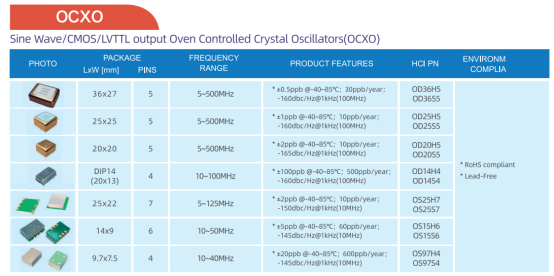
IV. Hangjing Electronics OCXO Series Selection Showcase
V. Conclusion
As national infrastructure becomes increasingly digitalized and networked, high-precision time synchronization has emerged as an essential "invisible backbone" supporting reliable system operations. Satellite-calibrated OCXOs combine the global accuracy of satellite signals with the short-term stability of local oscillators, establishing a critical time redundancy barrier during signal anomalies. In the future, with the continued enhancement of autonomous navigation systems like BeiDou and the expansion of new application scenarios such as the Internet of Things (IoT) and Industrial Internet, this technology will play an indispensable role across more critical domains, reinforcing the security of time references for next-generation infrastructure.
trending news
Contact Us