


Sorry, no sales person is available right now to take your call. Pls leave a message and we will reply to you via email as soon as possible.
Home/ Industry News/ Advantages and Disadvantages of RJ45 Integrated Network Transformers
Advantages and Disadvantages of RJ45 Integrated Network Transformers
2026-05-28
Comparison of Wiring and Design Between RJ45 Connectors With and Without Integrated Magnetics
The RJ45 connector is the core interface for Ethernet communication. Depending on whether it integrates network magnetics (Magnetics), its design can be categorized into two types: **integrated (with magnetics)** and **discrete (without magnetics)**. These two approaches differ significantly in circuit design, wiring complexity, cost, and performance. Below is a detailed comparison from the perspective of wiring and design.
1. Integrated RJ45 (With Magnetics)
1. Advantages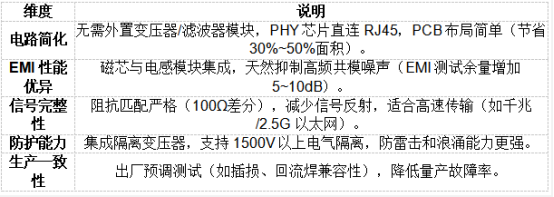
2. Disadvantages
Typical Applications: Industrial control equipment (e.g., PLCs), Gigabit switches, and industrial-grade PoE-powered devices.
2. Discrete RJ45 (Without Magnetics)
1. Advantages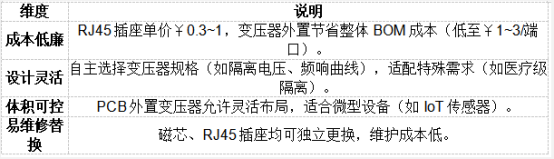
2. Disadvantages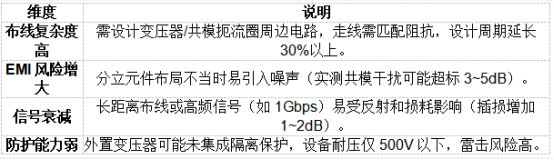
Typical Applications: Consumer-grade routers, home security devices, and low-speed (10/100Mbps) industrial terminals.
3. Wiring and Design Comparison
1. Circuit Design Complexity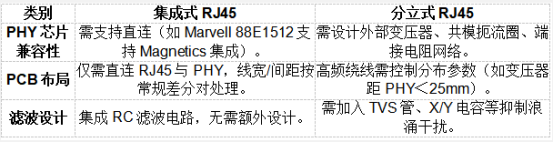
2. PoE Power Delivery Compatibility
3. High-Frequency Performance (Taking 1Gbps as an Example)
4. Recommended Application Scenarios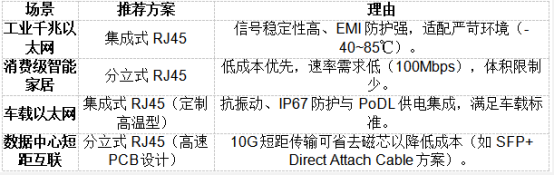
5. Summary
Integrated RJ45 connectors (with magnetics) simplify design and enhance reliability but come with higher cost and larger size. Discrete RJ45 connectors (without magnetics) offer advantages in cost control and design flexibility but require more engineering resources.
Key Decision Factors:
Cost Priority: Discrete solutions are preferred for high-volume production, while integrated solutions suit premium applications.
Speed and Distance: Integrated solutions are mandatory for Gigabit speeds or long-distance transmission; discrete solutions may suffice for 10/100Mbps over short distances.
Environmental Requirements: Integrated solutions are necessary for industrial-grade EMC and protection; discrete solutions are acceptable for consumer electronics.
Future Trend: As 10G PHY costs decline, integrated RJ45 connectors are expected to replace discrete solutions in more applications, driving Ethernet interfaces toward modularization and higher integration.
trending news
Contact Us